A kitchen can look current on launch day and feel dated surprisingly quickly if every decision is driven by fashion alone. The most useful kitchen design trends 2026 are not the loudest ones on social media. They are the ideas that make everyday cooking, storage and family life work better, while still looking considered years from now.
For homeowners planning a renovation, that distinction matters. A new kitchen is a major investment, and most people want it to feel fresh without having to revisit the whole scheme in five years. That is why 2026 is shaping up to be less about showy features and more about balance – warmth with practicality, technology with simplicity, and style with long-term durability.
Kitchen design trends 2026 are moving towards quieter confidence
The big shift is away from kitchens that try to impress at first glance and towards spaces that reveal their quality over time. In practical terms, this means more layered materials, better planning and finishes that feel lived-in rather than stark.
White high-gloss schemes are no longer the default aspiration for many households. Instead, softer tones, textured surfaces and furniture-style details are becoming more appealing. That does not mean traditional kitchens are taking over, nor that ultra-modern kitchens are disappearing. It means the lines between the two are softening. A contemporary kitchen may now include timber grain, fluted glass or warm metallic accents. A classic painted kitchen may include streamlined handleless elements or a highly engineered storage system.
This is good news for homeowners who want a kitchen that reflects their own taste rather than a passing look. The best rooms in 2026 will feel personal and well resolved, not copied from a trend board.
Colour is getting warmer and more grounded
Cool greys have been fading for some time, and 2026 will push that further. Expect to see more earthy greens, clay tones, mushroom shades, deep blue-greys and soft taupes. These colours bring warmth without overpowering the room, and they work especially well in British homes where natural light can vary across the day.
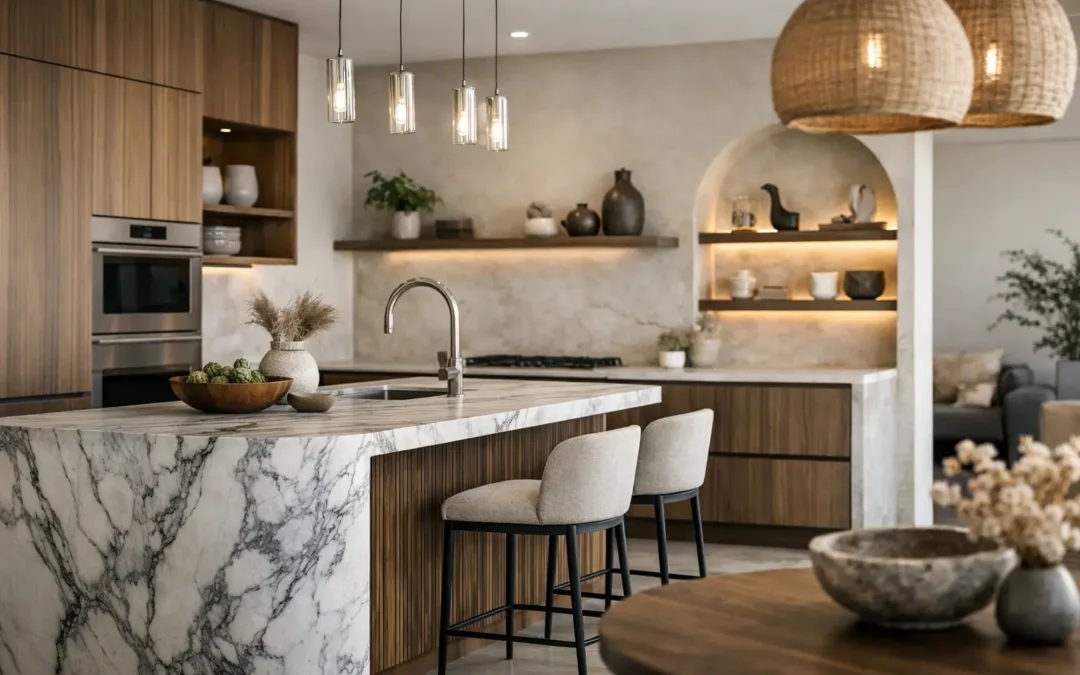
Timber is also playing a larger role, whether through full cabinetry, breakfast bars, open shelving or internal drawer detailing. Lighter oak keeps a room airy, while darker wood stains add depth and a more tailored feel. Painted and timber combinations are especially effective because they stop a kitchen feeling flat.
That said, colour choice still depends on the space. A large open-plan room can handle richer cabinetry and stronger contrast. A smaller kitchen may benefit from lighter shades on the main run, with darker tones used on an island or dresser-style feature. What matters most is how the palette works with your flooring, worktops and the amount of daylight the room receives.
Worktops are becoming more tactile
Highly polished surfaces are giving way to finishes with a little more texture and softness. Natural and engineered stone remains popular, but the preference is shifting towards subtle veining, honed finishes and colours that sit comfortably with cabinetry rather than compete with it.
Porcelain continues to attract attention because it is hard-wearing and low maintenance, particularly for busy family kitchens. Quartz still has strong appeal for the same reason. Natural stone offers unique character, though it may require more care depending on the material chosen. This is one of those decisions where lifestyle matters more than trend. If you love the individuality of marble but want a surface that shrugs off daily wear, there may be a compromise to strike.
Storage is becoming less visible and more intelligent
One of the strongest kitchen design trends 2026 is the move towards cleaner sightlines. Not because people own less, but because they want the kitchen to feel calmer. Better storage is doing the heavy lifting here.
Larders, breakfast cupboards and pocket-door housings are growing in popularity because they keep appliances and food preparation zones accessible but out of view when not in use. Deep pan drawers remain a practical favourite, and internal organisation is improving too, with better inserts for cutlery, spices, recycling and awkward corner spaces.
This is where good design earns its keep. A beautiful door style will always matter, but thoughtful internal planning often makes the bigger difference in day-to-day use. The right layout can shorten prep time, reduce clutter on worktops and make the room easier for more than one person to use at once.
Households are also asking more from utility rooms, boot rooms and connected fitted spaces. In many homes, the kitchen no longer needs to do absolutely everything. If laundry, pet care or bulk storage can be moved nearby, the kitchen itself becomes more efficient and more enjoyable to spend time in.
The island is still important, but not always essential
Kitchen islands remain desirable, though 2026 is encouraging a more realistic approach. Not every room benefits from one. In some spaces, a peninsula, a generous dining table or an uninterrupted run of cabinetry will work better.
Where islands do suit the layout, they are becoming more purposeful. Some are dedicated prep zones with a sink and bins. Others are sociable hubs with seating and statement lighting. Some combine storage on one side with furniture-style detailing on the other so they feel less like a block in the middle of the room.
The key is circulation. If an island leaves too little room to move comfortably, it will frustrate you long after the novelty has worn off. A well-planned kitchen should feel easy to use, especially at busy times of day.
Appliances are blending in, not showing off
Technology in the kitchen is becoming more refined. Rather than shouting about itself, it is being integrated more carefully into the overall design. Appliance banks are still common, but there is less appetite for a wall of black glass if it dominates the room.
Boiling water taps, venting hobs, smart ovens and integrated refrigeration all have genuine appeal when they improve convenience and free up space. But not every innovation is worth the premium. Some households will use advanced cooking functions daily. Others will never move beyond a handful of settings.
The practical question is simple: will this feature make the kitchen work better for you? If the answer is yes, it may justify the cost. If not, a simpler specification often gives better long-term value.
Lighting follows the same principle. Layered lighting is now expected rather than optional, with task lighting, ambient lighting and feature lighting all playing a role. Under-cabinet lighting, glazed cabinet illumination and dimmable pendants can transform how a kitchen feels, particularly in the evening. Good lighting makes materials look better and the room more comfortable to live in.
Details are becoming more architectural
One noticeable change for 2026 is the rise of subtle detailing that gives kitchens more character. Fluted textures, framed doors, ribbed glass, slim shaker profiles and mixed materials are all being used to add depth without making the room feel busy.
Metal finishes are warming up too. Antique brass, brushed bronze and softer black finishes feel more settled than bright chrome in many schemes. Again, restraint matters. A few carefully chosen accents can elevate the design, while too many competing finishes can make it feel disjointed.
Open shelving has not disappeared, but it is being used more sparingly. Homeowners still like the chance to display ceramics, glassware or cookbooks, yet many have learned that too much open storage creates visual clutter. A balanced approach usually works best – enough display to add personality, with plenty of concealed storage elsewhere.
Sustainability is becoming more practical
Sustainable choices are increasingly part of kitchen planning, though often in a grounded, less performative way. Customers are asking where materials come from, how long products will last and whether components can be repaired or replaced rather than discarded.
Durability is part of this conversation. A kitchen that still works beautifully after many years is a more sustainable choice than one that needs replacing early. Quality cabinetry, dependable hinges and drawers, and surfaces suited to real family life all matter here. So does choosing a design you will still enjoy living with once short-term trends have moved on.
For many homeowners, sustainability also means making fewer but better decisions. Investing in timeless foundations and using decorative elements more selectively is often the wiser route.
What homeowners should be careful of in 2026
Not every trend deserves equal weight. Very dark schemes can look striking, but in rooms with limited natural light they may feel heavy. Strongly veined worktops can be beautiful, but if paired with patterned doors, splashbacks and flooring they may create too much visual competition. Handleless kitchens can look elegant, though some users still prefer the feel and accessibility of a well-chosen handle.
There is also a risk of overfitting a kitchen to current habits. A coffee station sounds ideal, but only if you will use it every day. Extra seating at an island may be useful for some families and largely decorative for others. Good design starts with how you live now, then allows enough flexibility for the years ahead.
That is often where an experienced showroom-led design process makes the biggest difference. Seeing finishes together, testing storage ideas and discussing layout options in detail helps turn abstract trends into sensible choices for a specific home. For homeowners in and around Maidstone, that practical guidance can be the difference between a kitchen that photographs well and one that genuinely improves daily life.
The strongest trend for 2026 is not a colour, a door style or a gadget. It is confidence in choosing a kitchen that suits your home properly, works hard every day and still feels right long after the brochures have changed.