A wardrobe can occupy the largest uninterrupted wall in a bedroom, so its doors affect far more than the appearance of the room. When deciding between sliding or hinged wardrobes, the right answer depends on your available floor space, how you use your storage and the style you want to create. A door that looks excellent in a showroom may not be the best choice beside a bed, beneath a sloping ceiling or in a busy family bedroom.
The most successful fitted bedrooms begin with the room itself rather than a fixed preference for one door type. Consider where people walk, where drawers need to open, what you need to store and whether more than one person will be getting ready at the same time. Those practical details usually make the decision clearer.
Sliding or hinged wardrobes: the main difference
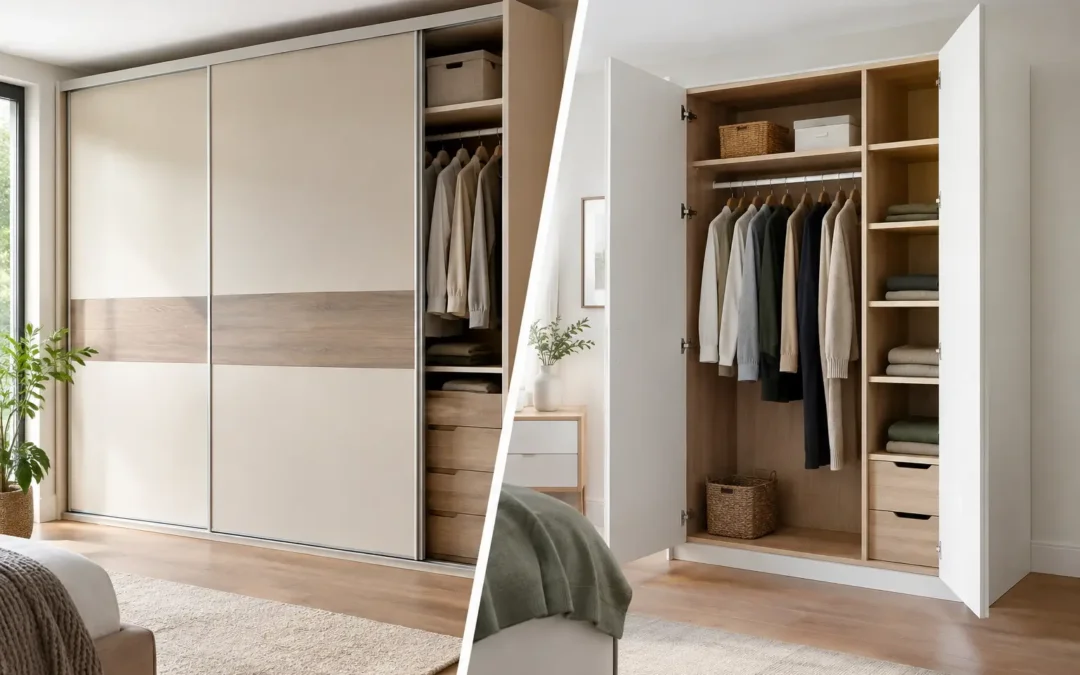
Sliding wardrobe doors move sideways across the front of the furniture on a track. Because they do not swing into the room, they are particularly useful where there is limited clearance between the wardrobe and the bed. They give a broad, uninterrupted frontage and can create a calm, contemporary look, especially in larger bedrooms.
Hinged doors open outward on hinges, much like a conventional cupboard door. They need clear floor space in front of the wardrobe, but they reveal the full width of a section at once. This makes it easier to see clothes, shelves and drawers without moving a door aside first.
Neither option is automatically better. Sliding doors tend to solve a space-planning problem, while hinged doors often offer the most convenient everyday access. The best design balances both factors instead of treating the choice as purely decorative.
When sliding wardrobes make most sense
Sliding doors are often the practical answer in bedrooms where circulation is tight. If the gap between the bed and wardrobe is narrow, an outward-opening door can make the room awkward to use. A sliding front keeps that walkway clear, which can be especially valuable in a compact main bedroom, a guest room or a modern new-build property.
They also suit long runs of fitted storage. A wide wall can accommodate two, three or more large panels, giving the furniture a clean, architectural presence. Mirrored or glass-effect panels can reflect light and make a darker room feel more open, while textured finishes, timber effects and painted panels can make the wardrobe feel integrated with the rest of the scheme.
There is, however, a trade-off. With sliding doors, one portion of the wardrobe is always covered by another panel. You cannot access every section simultaneously. That rarely causes a problem for one person choosing an outfit, but it can feel less convenient when two people are sharing a wardrobe during the morning rush.
The internal layout needs careful thought too. Shelves and hanging rails should be planned around the door divisions, so the door positions do not obstruct useful access to frequently used areas. A well-designed interior makes this feel natural; a poorly planned one can make a generous wardrobe surprisingly frustrating.
Track quality matters
A sliding door should feel controlled and quiet, not light, rattly or difficult to move. Quality tracks, properly sized doors and accurate fitting are what make the difference over years of daily use. Very large panels can be impressive, but they must be specified with suitable hardware and materials rather than chosen for appearance alone.
Sliding systems may also require occasional cleaning of the bottom track, particularly in bedrooms with carpet fibres, pets or young children. This is a small maintenance task, but worth understanding before you choose.
Why hinged wardrobes remain a favourite
Hinged wardrobes are exceptionally flexible. Each door opens independently, allowing full access to a dedicated section of storage. You can open the area containing shirts, use an internal drawer and see exactly what is on the shelf above without moving another door first.
That full access is one reason hinged doors work so well for organised storage. They accommodate a wide range of interior arrangements, including pull-out drawers, shoe shelving, laundry storage, tie racks and internal mirrors. If your wardrobe needs to hold a varied collection of clothing rather than simply provide hanging space, hinged doors can make day-to-day use easier.
They are also well suited to more detailed bedroom styles. Shaker, framed, panelled and traditionally styled doors all work naturally with hinges. In a period home or a bedroom with classic furniture, hinged wardrobes can look like crafted cabinetry rather than a large bank of storage.
Modern hinged wardrobes should not be dismissed as traditional, though. Handleless doors, discreet integrated pulls and clean matt finishes can produce a very contemporary result. The door mechanism does not dictate the style; proportions, finishes and detailing do.
The limitation is clearance. Before choosing hinged doors, measure the distance between the wardrobe and the bed, chest of drawers or opposite wall. You need room to open a door comfortably and still stand in front of the storage. In some rooms, a narrower door configuration can help, but it cannot overcome a fundamentally tight layout.
Consider the room before the door style
The size and shape of the bedroom should lead the design decision. A narrow room with a bed opposite the wardrobe will often favour sliding doors. A wider room with generous circulation may gain more from hinged doors and their unrestricted access.
Ceiling height matters too. Fitted wardrobes that run close to the ceiling make better use of vertical space and reduce the dust-catching gap above freestanding furniture. Hinged doors can work very well at full height, although tall doors require suitable hinges and careful alignment. Sliding doors can also be made to impressive heights, subject to the system selected and the practicalities of the room.
Awkward features deserve attention at the planning stage. Chimney breasts, alcoves, loft slopes, radiators, sockets and window positions all influence the furniture layout. A wardrobe design should work around these features intelligently rather than merely conceal them. In an attic room, for example, a combination of hinged doors, open shelving and made-to-measure units may use the available shape better than trying to force one uniform door style across every section.
Storage habits should shape the interior
The question is not simply how much storage you need, but how you use it. Someone with long dresses, suits and coats needs more full-height hanging. A family wardrobe may need lower rails for children, deep drawers for knitwear and accessible shelves for bedding. A compact bedroom may benefit from fewer hanging rails and more carefully planned folded storage.
Think about what you reach for every day. Frequently worn clothes should sit between waist and eye level, while seasonal items can go in higher cupboards. Shoes are easier to manage on angled or shallow shelves than in a deep, dark base unit. Small accessories benefit from drawers with compartments rather than being lost at the back of a shelf.
This is where a showroom consultation is genuinely useful. Seeing door finishes and storage fittings in person is helpful, but so is discussing the realities of your room and routine with an experienced designer. At MBK Design Studio, the aim is to create fitted bedroom furniture that looks right on day one and remains practical long after the novelty of a new room has passed.
Style, finishes and the feeling of the room
Sliding doors can make a statement with large panels and minimal visual interruption. They suit sleek schemes, especially where the bedroom already has simple lines, contemporary lighting and restrained colour. A pale matt finish can make the wardrobe recede, while a darker timber or coloured glass panel can turn it into a confident focal point.
Hinged doors provide more opportunities for finer detail. Door frames, handles and panel proportions can echo the style of a dressing table, bedside furniture or even cabinetry elsewhere in the home. In a traditional setting, this continuity often feels more considered than a plain sliding front.
Mirrors deserve a practical decision rather than an automatic one. They can brighten a room and remove the need for a separate full-length mirror, but some homeowners prefer a calmer, softer appearance without large reflective surfaces. A mirror inside a hinged door can offer a useful alternative. With sliding wardrobes, a single mirrored panel can give the benefit without covering the entire frontage.
Budget and long-term value
Cost is influenced by far more than whether a door slides or hinges. The dimensions of the wardrobe, internal fittings, chosen finish, door construction, handles, lighting and the complexity of the room all affect the final price. A simple hinged wardrobe may cost less than a large sliding system, but a detailed hinged design with premium finishes and extensive internal storage may cost more.
It is sensible to compare like with like. Ask what is included in the furniture specification, how the interiors are configured and whether the proposed design genuinely uses the space well. The least expensive quotation can be poor value if it leaves awkward gaps, provides limited usable storage or relies on components that will not stand up to everyday use.
A fitted wardrobe is a long-term part of the home. Choosing durable doors and thoughtfully planned storage can reduce the temptation to replace it when your needs change slightly. Adjustable shelving, a sensible mix of hanging and drawers, and a finish you will still appreciate in several years are often better investments than the latest short-lived trend.
The right wardrobe door is the one that makes the bedroom easier to live in. Bring a rough room measurement, a few photographs and an honest account of what currently annoys you about your storage to your design discussion. That gives your designer the information needed to turn an everyday compromise into a bedroom that works beautifully from morning to night.