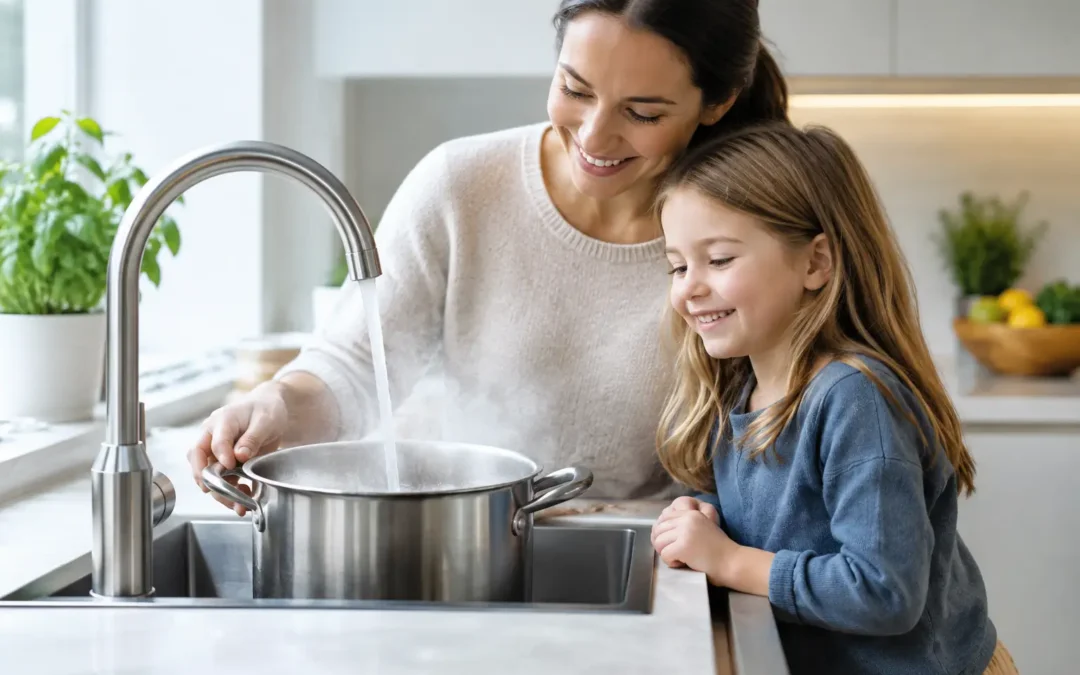
A boiling-water tap can make a busy kitchen feel noticeably easier to use. Tea, pasta, vegetables and cleaning jobs are faster, and there is no kettle left steaming on the worktop. But boiling taps safety deserves proper consideration before one becomes part of your kitchen design. Unlike a kettle, the source of very hot water is fixed in place and used many times a day by everyone in the household.
For most homeowners, the right question is not whether a boiling-water tap is safe in principle. Well-specified, correctly fitted products have several purposeful safeguards. The more useful question is whether the tap, its position and the way your household uses the kitchen make those safeguards effective in real life.
Why boiling taps safety needs careful planning
Water close to boiling temperature can cause a serious scald in seconds. That is true whether it comes from a kettle, saucepan or specialist tap. A boiling-water tap removes some familiar hazards, such as carrying a full kettle across the kitchen, but it introduces a different set of considerations: accidental activation, a child reaching the controls, an exposed spout and a hurried user holding the wrong container.
The benefits can still be considerable. For someone who drinks hot drinks regularly, has limited grip strength, or simply wants a clearer worktop, the convenience is genuine. In a family kitchen, however, convenience should be balanced with who uses the space, how closely children are supervised and whether the tap will be positioned in a busy route between the hob, fridge and dining area.
A good kitchen design considers the whole workflow rather than treating the tap as a standalone purchase. The sink, draining board, bins, sockets, worktop depth and storage all influence how safely hot water can be drawn.
Safety features worth looking for
Not all boiling-water taps operate in the same way. Before choosing a model, ask to see exactly how the boiling-water function is activated. It should require a deliberate action that is clearly different from drawing ordinary hot or cold water.
Child-safe controls
Many products use a push-and-turn, press-and-hold or double-action control for boiling water. This helps prevent the tap being operated casually or by a child copying what they have seen an adult do. It is not a substitute for supervision, but it creates a useful barrier between an everyday movement and a potentially dangerous one.
Try the mechanism in person if possible. It needs to be secure, but also practical for the people who will use it most. A control that is awkward for an older relative or someone with reduced hand strength may lead to rushed handling, which defeats the point of choosing it.
Insulated spouts and controlled flow
A well-designed tap will limit how hot the outside of the spout becomes. This reduces the chance of a burn from touching the metal after hot water has been drawn. The boiling-water outlet should also deliver a controlled, aerated flow rather than a forceful jet, helping to reduce splashing when filling a mug or pan.
The shape and height of the spout matter too. A high, sweeping spout can look elegant, but it must direct water into the centre of the bowl rather than onto the edge of a shallow sink. The best option depends on your sink depth, bowl size and the pans you use.
Clear separation from ordinary water
Some taps combine hot, cold and boiling-water functions in one appliance. Others have separate outlets. Either approach can work well, provided the controls are intuitive and easy to distinguish at a glance.
This is especially relevant in a household with guests, teenagers or visiting grandchildren. If someone has never used the tap before, they should not have to guess which lever produces boiling water. Clear markings, a distinct control action and a short explanation for visitors are sensible precautions.
Tank and cabinet protection
The compact tank beneath the sink is a vital part of the system. It needs adequate space, correct ventilation where specified by the manufacturer, and access for servicing. The cupboard should not become an overcrowded place for cleaning bottles, carrier bags and loose household items.
Consider a protective tray or leak-detection feature where available, particularly if you are investing in a high-quality cabinet finish. It will not prevent every issue, but early warning of a leak can protect the furniture and give you time to act.
Designing a safer place to draw boiling water
Boiling tap safety begins with location. The sink should be a stable, well-lit working area with sufficient worktop space alongside it. There should be somewhere to set down a mug or pan before and after filling it, without reaching across the sink or around another person.
Avoid placing the boiling-water tap where someone is likely to brush past the controls while unloading the dishwasher or passing through a narrow kitchen route. In compact kitchens, this may mean paying closer attention to handle direction and the relationship between the sink and nearby appliances.
A deeper sink bowl is often more forgiving than a very shallow one because it contains splashes more effectively. A drainer or adjacent stretch of worktop also gives you a safe landing place for hot cookware. If a boiling-water tap is primarily intended for filling pans, check that the pan can sit securely in the sink or on the worktop while being filled. Holding a pan in mid-air is never the safer option.
For households with young children, think about visibility as well as reach. A sink positioned where an adult can see it from the main preparation area is easier to supervise than one tucked around a corner. A boiling-water tap should also be part of wider kitchen safety planning, including sensible storage of knives, cleaning products and cooking equipment.
Everyday habits that make the difference
The strongest safety feature is still a calm, consistent routine. Use a stable, heat-resistant mug or jug and place it in the sink before activating the boiling-water function. Keep hands away from the spout and do not overfill containers, particularly narrow mugs that can splash back.
It is sensible to let visitors know that the kitchen has a boiling-water tap. This takes seconds and avoids the common assumption that every tap works like a conventional mixer. Children should understand that the special control is not for play, even when it has a safety catch.
Never treat boiling water as ordinary hot water when cleaning. Draw only the amount needed and use suitable gloves or utensils when necessary. A hot tap can make degreasing a roasting tin easier, but pouring very hot water into cold, delicate glassware or onto a damaged surface can create another problem.
Routine care also matters. Follow the manufacturer’s guidance for filter changes, cleaning and descaling. In hard-water areas of Kent, limescale can affect the performance and appearance of kitchen equipment over time. Regular care helps the system operate as intended and gives you an opportunity to spot drips, loose controls or changes in flow before they become a larger concern.
Is a boiling-water tap right for every household?
Not necessarily. A conventional kettle may remain the better choice where boiling water is used infrequently, budgets are tightly controlled, or household routines make a fixed source of very hot water less appealing. A boiling-water tap also requires room beneath the sink for its tank and associated components, which can reduce storage in a compact kitchen.
For many homeowners, though, it is a worthwhile addition when chosen as part of a considered kitchen plan. The appeal is not simply speed. It is the ability to create a calmer, less cluttered preparation area while reducing the need to lift and carry a heavy kettle.
At MBK Design Studio, we encourage clients to try tap controls in the showroom and discuss how their kitchen is genuinely used, rather than selecting features from a photograph. A beautiful kitchen should make everyday life easier, but it should also feel comfortable and safe for every person who shares it.
The best boiling-water tap is one that suits your household, sits naturally within the kitchen layout and encourages careful habits without making simple tasks feel complicated. That is where thoughtful design earns its place long after the renovation is complete.