The moment a Neff Slide Hide door disappears beneath the oven cavity, the benefit is obvious: there is no hot door projecting into the room while you lift out a roasting tray or check a cake. This Neff Slide Hide oven review looks beyond that memorable feature to answer the more useful question for a kitchen renovation: does it genuinely improve everyday cooking enough to justify its place, and its cost, in your design?
For many households, it can. The door makes a real difference where several people cook together, where the oven sits close to a walkway, or where comfort and access are priorities. It is not, however, an automatic choice for every kitchen. The best decision depends on how you use your oven, which model specification you choose and how the appliance fits into the wider layout.
What makes a Neff Slide Hide oven different?
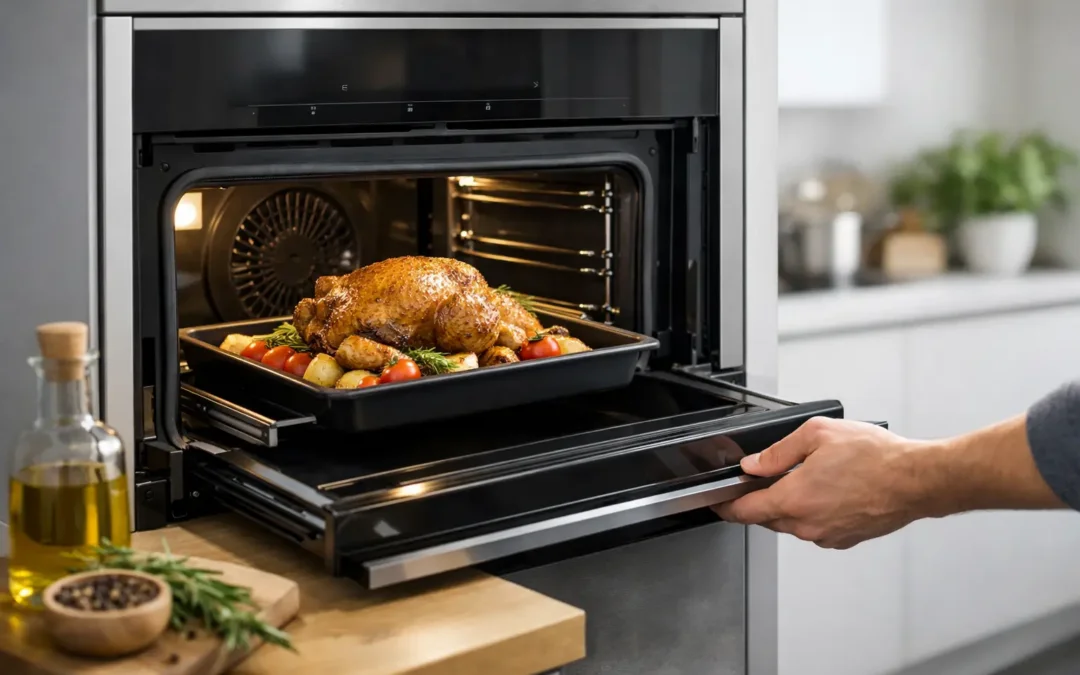
Slide&Hide is Neff’s retracting oven-door design. Instead of opening downwards and remaining in front of the appliance, the fully opening door slides smoothly underneath the oven cavity. You retain access to the full width of the oven, without leaning over a door to reach the shelves.
That matters more than it may sound in a showroom. A conventional open oven door can restrict the route through a kitchen, particularly in a compact room or an island arrangement. With Slide&Hide, the cook can stand closer to the cavity, inspect food at eye level in a tall housing and remove heavier dishes with more confidence.
It is also a thoughtful detail for family cooking. There is less temptation for somebody to step over a hot, open door while passing through the kitchen. It does not remove the need for sensible care around a hot appliance, of course, but it can make a busy room feel less obstructed.
The cooking performance is the bigger test
A clever door alone would not make an oven worth choosing. Neff’s Slide&Hide range includes models with varying cooking functions, capacities, controls and cleaning systems, so the badge does not tell the whole story. The individual model matters.
Many homeowners are drawn to features such as CircoTherm fan cooking, designed to circulate heat efficiently and, on suitable models, cook different dishes on multiple levels with less transfer of flavours. For a Sunday lunch followed by a dessert, or for batch cooking during the week, this can be genuinely useful. Other models may offer steam assistance, a temperature probe, microwave combination cooking or connected controls.
The right specification should reflect your habits rather than a wish list. If you regularly cook several dishes at once, use the oven for entertaining and want flexibility, a higher-spec model can earn its place. If the oven is mainly used for family suppers, baking and the occasional roast, a well-chosen standard multifunction Slide&Hide model may offer the same practical door benefit without paying for features that will rarely be used.
Capacity is another point to check carefully. A large cavity is welcome for trays, turkey roasting and entertaining, but external dimensions must work with the housing and surrounding appliances. During kitchen planning, the oven position, shelf height, adjacent worktop space and opening direction all deserve as much attention as the finish of the cabinetry.
Where the retracting door is most valuable
The strongest case for Slide&Hide is usually a built-in oven at a comfortable working height. With the door out of the way, a hot tray can move directly from oven to worktop without the usual reach over glass and metal. This is particularly appealing for keen bakers, for anyone who cooks with heavier cookware, and for households that use their kitchen as a social space.
It can also be useful in a narrower kitchen, although it is not a substitute for good space planning. You still need safe landing space nearby for hot dishes, clear access to the oven controls and enough room to open adjacent cupboards and appliances. An attractive appliance cannot solve a compromised layout on its own.
Neff Slide Hide oven review: the trade-offs to consider
The Slide&Hide mechanism is more complex than a conventional drop-down door, and that brings a few practical considerations. The oven generally commands a premium over a comparable Neff model without the retracting feature. Whether that represents good value comes down to how often you will appreciate the extra access.
Cleaning needs thought too. The door mechanism is designed for normal everyday use, but it is another component to keep free from obvious spills and residue. Cleaning programmes differ by model. Some ovens offer pyrolytic self-cleaning, which uses high heat to reduce baked-on deposits to ash; others use easier-clean enamel, catalytic liners or steam-based cleaning assistance. These are not interchangeable, so it is worth confirming the exact cleaning method before making a final selection.
Pyrolytic cleaning is particularly convenient for households that cook frequently, but it may add to the purchase price and uses a high-temperature cycle. Easier-clean systems can be perfectly adequate where the oven is wiped after use and deep cleaning is less frequent. There is no single right answer, only the level of maintenance you realistically want to take on.
The door’s appearance may divide opinion. Some people love the theatre of it, while others simply want a straightforward appliance and see no need to pay extra. It is worth operating the mechanism yourself, rather than deciding from photographs. It should feel reassuringly smooth and practical, not like a feature you are buying because it looks impressive for the first week.
Controls, cleaning and long-term use
Neff ovens are available with different control styles, from traditional knobs and clear digital displays to more advanced touch interfaces. Touch controls can create a clean, contemporary look and make settings precise, but some cooks prefer physical controls when their hands are wet or busy. This is a personal preference that is easy to overlook when choosing appliances as part of a larger renovation.
Look at the everyday details in person where possible. Are the shelves easy to reposition? Does the telescopic rail system feel useful for your cooking? Can you read the display from your usual working position? Is the internal lighting bright enough to check food without opening the door? Small answers often determine whether an appliance remains a pleasure to use years later.
Energy ratings, oven functions and available accessories can also vary between current models. Rather than assuming every Slide&Hide oven includes a particular function, compare the specification of the exact appliance under consideration. This protects your budget and avoids disappointment after the kitchen is complete.
Planning the oven into a new kitchen
An oven should be selected alongside the kitchen design, not as an afterthought. A tall bank of appliances can make Slide&Hide particularly compelling, especially when positioned at a height that minimises bending. A single oven below a hob may still benefit from the retracting door, though the gain is less pronounced because you are naturally bending down to use it.
Consider where hot trays will be placed. Ideally, there should be a clear worktop close by, without a sink, a busy doorway or a tall cupboard handle interfering with the route. If the kitchen includes two ovens, a combination microwave or a warming drawer, the visual alignment and practical relationship between them should be planned as one composition.
At MBK Design Studio, appliance selection is considered as part of the wider room, including how clients cook, the style they want to achieve and the budget available for the project. That conversation is valuable because a premium appliance feature can be either a daily convenience or an unnecessary expense, depending on the household.
Is a Neff Slide Hide oven worth the cost?
For a keen cook, a family kitchen or an eye-level oven position, the answer is often yes. The unobstructed access is not a gimmick when you are lifting out a full casserole, rotating baking trays or sharing the kitchen with others. It is a feature you notice repeatedly, not just when showing the room to visitors.
For a smaller budget, or for a kitchen where the oven will be used lightly and positioned below the hob, the money may be better directed towards the functions you will use most, a higher-quality extraction solution or more useful storage. A conventional Neff oven can still deliver excellent cooking performance.
The most satisfying kitchen choices are the ones that make ordinary routines easier. If the Slide&Hide door feels useful when you picture a busy Wednesday evening as much as it does when you picture a finished showroom kitchen, it is likely to be a worthwhile addition to your plans.