A traditional kitchen earns its place through proportion, materials and the small decisions that make the room feel settled rather than staged. This guide to traditional kitchen details is for homeowners who want warmth and character, but also need a kitchen that works hard for family life, entertaining and everyday routines.
The most successful schemes do not rely on one dramatic feature. They bring cabinetry, worktops, handles, lighting and practical storage together in a way that suits the property and the people living in it. Whether your home is a Kent cottage, a Victorian terrace or a newer house that needs more personality, the right details can create a kitchen that feels as though it belongs.
Start with the character of the room
Traditional does not have to mean dark, formal or overly ornate. A painted shaker kitchen with simple brass handles can feel calm and contemporary, while framed cabinets, a Belfast sink and aged timber accents can create a more classic country look. The starting point should be the architecture of your home, alongside the atmosphere you want to create.
Look carefully at ceiling height, window positions, original features and natural light. In a period property, an over-sized cornice or a decorative mantle may feel entirely at home. In a smaller or newer kitchen, the same elements may need a lighter touch. Good traditional design is not about adding every possible feature. It is about choosing the details that give the room a sense of permanence.
Colour also changes the character considerably. Soft whites, muted greens, stone, warm grey and deep blue are enduring choices because they sit comfortably with timber, natural stone and metal finishes. Darker cabinetry can be striking, but it needs enough daylight and carefully planned lighting to avoid making the room feel enclosed.
Traditional kitchen cabinetry: framed, shaker or in-frame?
Cabinetry has the greatest visual impact, so it is worth understanding the differences before focusing on decorative extras. Shaker doors are defined by their simple recessed centre panel and clean lines. They are versatile, suit both town and country homes, and can be adapted with colour and hardware.
In-frame cabinetry has doors and drawer fronts set within a visible frame. It offers a more crafted appearance, with fine gaps around each door that give depth and shadow. This construction is often associated with high-quality traditional furniture and can be especially effective in homes with period features. It may cost more than a standard lay-on door kitchen, however, due to the additional materials and workmanship involved.
A more decorative raised-panel door suits grander settings, but can feel busy in a compact kitchen. If you love this look, balance it with quieter worktops, simple wall colours and fewer open shelves. The aim is to give the cabinetry room to be appreciated.
Make storage look considered
Traditional kitchens should be practical, not museum pieces. A larder cupboard, deep pan drawers and integrated bins make daily use easier without interrupting the furniture-like appearance. Tall cupboards can be broken up with glazed sections, open shelving or a dresser-style arrangement, particularly where a full wall of cabinetry would feel heavy.
Furniture details matter here. Feet, end panels, pilasters and cornices can make fitted units feel more bespoke, but they should be in proportion to the room. A narrow kitchen usually benefits from restrained detailing; a generous farmhouse kitchen can carry a more substantial mantle and wider plinth.
Choose worktops for use as well as appearance
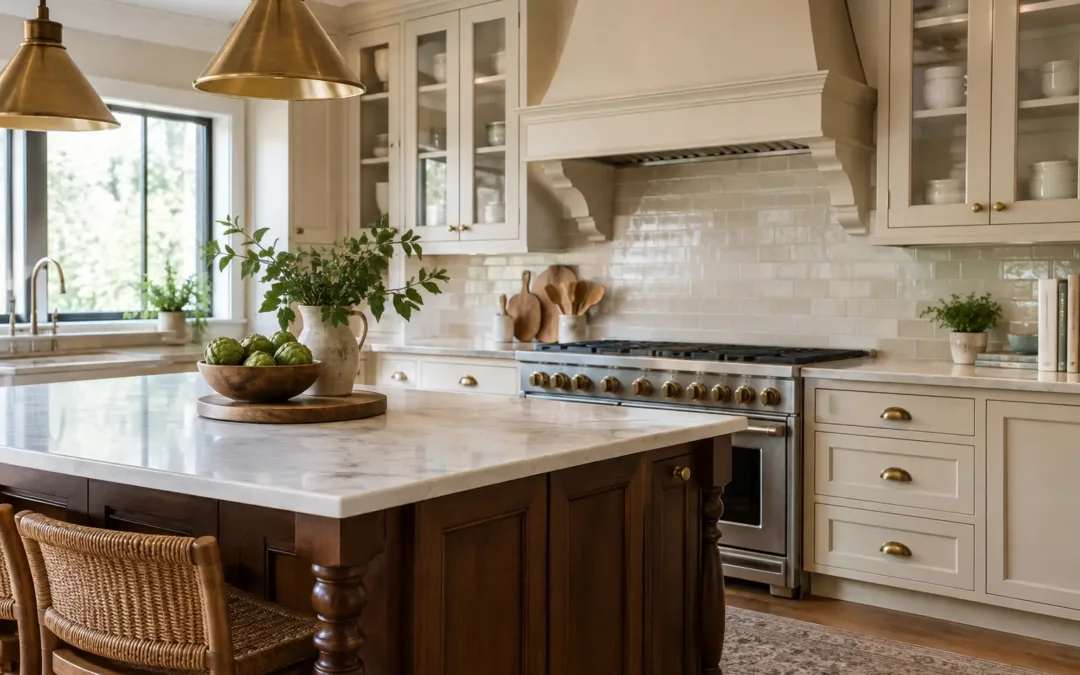
Natural materials are central to many traditional kitchen schemes. Timber has warmth and develops character over time, although it needs regular care and protection from standing water. It works particularly well on an island, breakfast bar or dresser section, paired with a more hard-wearing material around the sink and hob.
Stone and stone-effect worktops offer a different balance. Quartz can provide the appearance of natural stone with a consistent finish and straightforward everyday maintenance. Granite has distinctive movement and variation, while marble brings unmistakable elegance but is more susceptible to staining and etching. There is no universally correct choice. The best option depends on how you cook, how much maintenance you are comfortable with and the finish you genuinely enjoy.
A thicker worktop profile can reinforce a traditional feel, especially with a Belfast or ceramic sink. Consider the edge detail too. A simple square edge is understated; a softly rounded or moulded profile can add refinement without becoming fussy.
Sinks, taps and hardware add the personality
A Belfast sink is a familiar traditional choice for good reason. Its generous bowl is useful for large pans and it creates a strong focal point beneath a window. It does, however, require suitable cabinet support and enough worktop depth, so it is not always the most practical answer in a compact layout.
Ceramic undermount or inset sinks can give a similarly timeless appearance with slightly more flexibility. Pairing either with a bridge tap, swan-neck tap or classic mixer can reinforce the style. Brass, antique bronze, polished nickel and chrome all have their place. Brass feels warmer and often gains a natural patina; chrome is brighter and easier to coordinate with many appliances and accessories.
Handles are small but highly visible. Cup handles and knobs create a traditional, familiar feel, while bar handles can make shaker furniture look more tailored and less formal. Try samples against the cabinet colour and worktop before committing. A handle that looks beautiful in isolation can disappear against a dark door or feel too delicate on a large drawer.
Build depth with lighting and wall finishes
Lighting is where many otherwise attractive kitchens fall short. One central ceiling fitting rarely provides enough useful task light, particularly over preparation areas. A layered approach is more comfortable and more flattering to the room: practical light over worktops, softer ambient light for the wider space, and feature lighting where it adds purpose.
Pendant lights over an island or dining table can introduce period character through glass, ceramic, aged metal or pleated shades. Under-cabinet lighting keeps work areas usable in the evening without compromising the traditional look. Wall lights can be an appealing alternative where there is limited room for pendants, although their position needs to be planned around wall units and sightlines.
For walls, metro tiles, handmade-look ceramics, tongue-and-groove panelling and painted plaster all work well. Handmade tiles have variation in tone and surface, which gives a kitchen a relaxed, lived-in quality. They can cost more and take more time to set out well, but the result often feels less uniform than a standard tile. If you prefer a quieter backdrop, a painted splashback behind the hob and a more durable surface around the sink can be a sensible compromise.
Include an island only when it improves the layout
An island is often requested in traditional kitchens, but it must earn the floor space it occupies. It can provide welcome preparation room, storage, seating and a natural place for guests to gather. In a restricted room, though, an island can make access to cupboards and appliances frustrating.
A freestanding table or butcher’s block may offer a more authentic and flexible alternative. It can bring a furniture-like quality to the room and is easier to move or replace as your needs change. Where an island does fit, consider painted cabinetry with a timber top, turned legs or an open bookcase end to soften its fitted appearance.
Keep appliances discreet, but not inconvenient
Integrated appliances often help a traditional scheme feel calmer, especially when the kitchen is open to a living or dining area. A built-in fridge freezer, dishwasher and concealed extractor allow cabinetry and materials to take centre stage.
That said, a range cooker can become a defining feature of a traditional kitchen. Its size, fuel type, ventilation requirements and surrounding clearance all need to be considered early in the design. The same is true of a statement cooker hood or mantle. These are not simply decorative choices: they affect the room’s layout, storage and budget.
The detail that makes it feel personal
The most convincing traditional kitchens avoid looking as though every component came from the same display. A painted dresser, a glazed cabinet for favourite glassware, a shelf for cookbooks or an antique-style wall light can make the room feel personal without creating clutter.
At MBK Design Studio, we find that the best results come from discussing how a household actually lives before selecting finishes. A kitchen designed around baking, family suppers, hosting friends or quiet morning coffee will make different demands on storage, seating and worktop space.
Before making final decisions, stand back from individual samples and consider the whole room. A traditional kitchen should feel composed, useful and comfortable from the moment you walk in. If the details support your daily life as well as the character of your home, they will continue to feel right long after the renovation is complete.