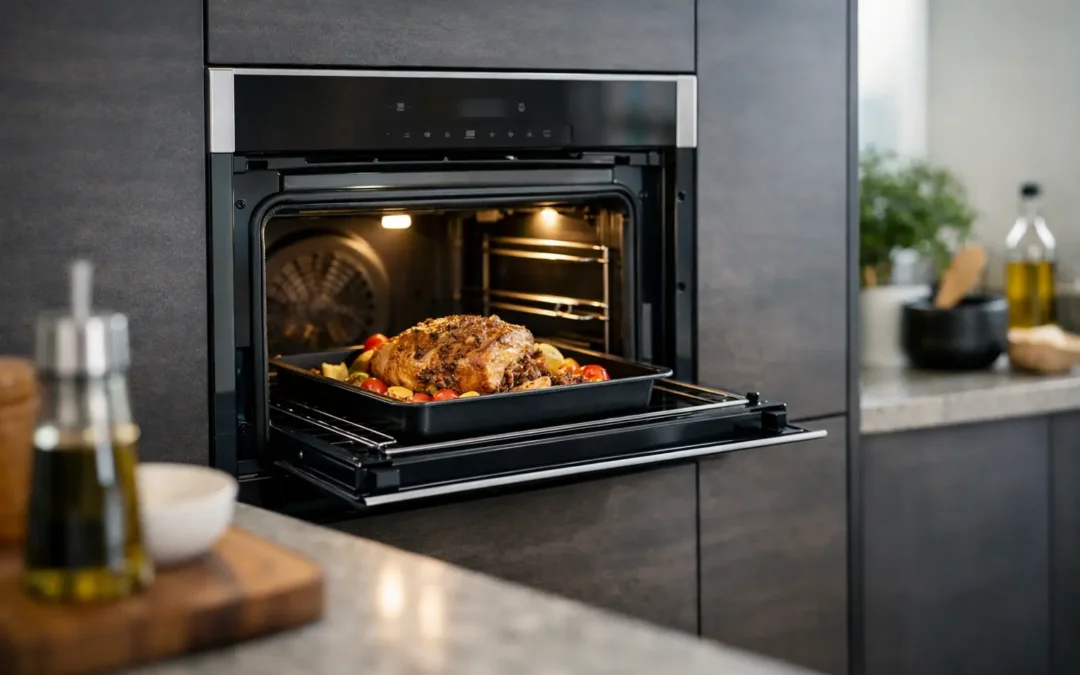
A hot roasting tray and an open oven door are an awkward combination in a busy kitchen. That is the everyday problem Neff set out to solve with its retracting oven door. In this Neff slide and hide review, we look beyond the clever showroom moment to ask the more useful question: does it make a meaningful difference once the kitchen is being used every day?
For many households, the answer is yes – particularly where the oven sits in a tall housing, the kitchen has a narrow working aisle, or more than one person regularly cooks at once. It is not a feature everyone needs, however, and it comes at a premium. The right choice depends on your cooking habits, kitchen layout and the specific Neff model under consideration.
What is Neff Slide and Hide?
Slide and Hide is Neff’s distinctive oven-door design. Rather than folding down and projecting into the room, the fully opened door slides beneath the oven cavity. The glass remains safely contained within the appliance, leaving clear access to the shelf and food inside.
It is a genuine functional difference, not simply a styling detail. With a conventional drop-down door, you must either lean over the glass to check a dish or stand back from it while removing a heavy casserole. With Slide and Hide, you can stand much closer to the oven and use both hands with fewer obstructions.
The mechanism is available on selected Neff single ovens and compact ovens, not across every appliance in the range. Features such as steam assistance, microwave functions, pyrolytic cleaning, connectivity and cooking programmes also vary by model. It is therefore worth comparing the exact specification, rather than assuming every Slide and Hide oven offers the same performance.
Neff Slide and Hide review: the practical benefits
The clearest advantage is access. Pulling out a roasting tin, lifting a loaf from a hot shelf or basting a joint feels more straightforward when there is no open door between you and the oven. For keen cooks, that can make an immediate and lasting difference.
It also helps create a more comfortable kitchen when space is limited. An open standard oven door occupies a surprising amount of floor area. In a galley kitchen, a compact L-shaped layout or a room with an island opposite the appliance bank, that obstruction can interrupt the route through the room. The retracting door does not make the kitchen bigger, but it can make the working space feel calmer and easier to navigate.
There is a safety benefit too. A door that is tucked away reduces the risk of someone catching a shin on it or a child moving too close to hot glass. It should never replace normal care around a hot appliance, of course, but removing one obstacle from a busy family kitchen is welcome.
The design is particularly appealing in eye-level oven arrangements. At this height, users can see and reach food more directly, while the clear opening makes the appliance feel less enclosed. For clients planning a new kitchen from scratch, this is one reason the feature often earns its place in a Neff appliance shortlist.
It is genuinely useful, not just theatrical
Slide and Hide is the kind of feature that attracts attention in a showroom, yet its value becomes most apparent in ordinary moments: checking dinner while another person passes behind you, transferring a baking tray to the worktop, or cleaning up after Sunday lunch.
That said, homeowners who mainly use their oven for simple weekday meals may not see the same benefit as enthusiastic bakers or frequent hosts. If budget is tight, consistent cooking results, usable capacity and easy cleaning should take priority over any individual convenience feature.
Cooking performance depends on the model, not the door
The retracting door itself does not cook food better. Neff’s cooking reputation instead rests on the technologies included within each oven. Many models offer CircoTherm hot-air cooking, designed to distribute heat so that several dishes can be cooked at once with less transfer of flavours. Higher-specification models may add grilling options, steam functions, temperature probes or automatic programmes.
This is where comparison matters. A basic Slide and Hide oven may suit a household wanting the door design and reliable everyday fan cooking. A more advanced model could be worthwhile for someone who bakes regularly, cooks for larger groups or wants extra flexibility without adding several appliances.
When viewing ovens, ask to see the interior shelving, controls and cleaning system as well as the door in action. A beautifully engineered door will not compensate for controls you find unintuitive or a cavity arrangement that does not suit the trays and dishes you use most often.
Cleaning: better access, but not a maintenance-free oven
A clear opening makes wiping the inside of the oven more comfortable, especially around the front edge and lower cavity. There is no door lying flat in the way, which is a modest but useful advantage after cooking.
However, the appliance still needs regular cleaning. Grease, sugar and cooking residue affect every oven, whatever its door design. Some Neff Slide and Hide models include pyrolytic self-cleaning, where the oven heats to a very high temperature and reduces residue to ash that can be wiped away once cool. Others use easier-clean linings or conventional cleaning methods.
Pyrolytic cleaning is convenient for households that use the oven heavily, but it adds to the initial cost and uses energy during the cleaning cycle. It is not essential for everyone. If you tend to wipe spills promptly and cook relatively lightly, a standard cleaning system may be perfectly adequate.
The sliding mechanism should be treated with sensible care. Follow the manufacturer’s cleaning instructions, avoid forcing the door and do not use unsuitable products around moving parts. The fact that the door retracts does not mean it is fragile, but it is more mechanically involved than a conventional hinged door.
Reliability and servicing: an honest consideration
A Slide and Hide door has additional moving components, so it is reasonable to ask whether this creates more to go wrong. In practice, many owners choose Neff precisely because they value the engineering and use the feature for years without issue. Nonetheless, more complexity can mean that repairs, should they be needed outside warranty, are more specialised than replacing a straightforward hinge.
This should not automatically put you off. It simply means buying from a reputable supplier, registering the appliance warranty and checking what local manufacturer support is available are sensible steps. It is also worth considering the wider appliance package. Choosing an oven based on a clear understanding of its features, warranty and long-term suitability is more reassuring than buying on a promotional price alone.
For a major kitchen renovation, appliance decisions should sit alongside the cabinetry design. Ventilation, electrical provision, appliance housing dimensions, door clearances and the height of the oven all need to work together. A well-planned tall housing can make a Slide and Hide oven feel natural to use, whereas a poorly positioned appliance will remain inconvenient whatever door it has.
Is the price premium justified?
Neff Slide and Hide ovens tend to cost more than comparable conventional-door models, and prices rise further with added steam, cleaning and smart features. The premium is justified when the retracting door solves a real layout or usability issue for you. It may also be worth paying for if cooking is a major part of how you enjoy your home.
It is less compelling if the oven will be used infrequently, there is generous clear space in front of it, or the budget would be better spent on a more capable conventional oven. A high-quality standard oven with the cooking functions you genuinely need is a better investment than an advanced model with features that will go unused.
Try the motion yourself before deciding. Open the door, stand in front of the cavity, imagine lifting out your heaviest dish and consider who will use it most. Shorter users, taller users and those with reduced mobility can experience the same layout very differently.
Who should choose a Slide and Hide oven?
The strongest case is for households that cook often and want a kitchen that supports rather than interrupts that routine. It is especially suited to compact kitchens, family homes with busy meal times, eye-level appliance banks and homeowners who value clear, safe access to the oven.
It may be less suitable for those seeking the lowest possible appliance cost or for kitchens where the oven door will never affect circulation. There is no wrong answer here. The best kitchen is one that reflects how you live, rather than one built around a feature that looks impressive but adds little value to your day.
At MBK Design Studio, we encourage clients to handle appliances during the planning stage, not select them from a specification sheet alone. The difference between a good kitchen and a kitchen you enjoy using often lies in these small, practical details.
A Neff Slide and Hide oven is not essential, but it is one of the more convincing examples of appliance innovation improving everyday use. If the clear access suits your layout and the chosen model has the cooking features you will use, it can be a worthwhile addition that still feels helpful long after the new-kitchen excitement has settled.