A shower can look beautifully considered and still feel awkward every morning if the controls are in the wrong place, slow to respond or unable to maintain a comfortable temperature. Knowing how to choose shower controls early in a bathroom refurbishment avoids one of the most frustrating compromises in the finished room. It also helps ensure the shower suits your household, your water system and the way you actually use the space.
For some homeowners, a simple temperature and flow control is exactly right. For others, separate controls for an overhead shower, handset and body jets make a daily routine more comfortable. The right answer is rarely about choosing the most complicated option. It is about selecting controls that deliver the experience you want, reliably and safely, for years to come.
Start with the shower experience you want
Before comparing finishes or handle styles, decide what the shower needs to do. A shower over a bath in a family bathroom has different priorities from a generous walk-in shower in an en-suite. Think about who will use it, how often it will be used and whether easy operation matters for children, guests or anyone with reduced mobility.
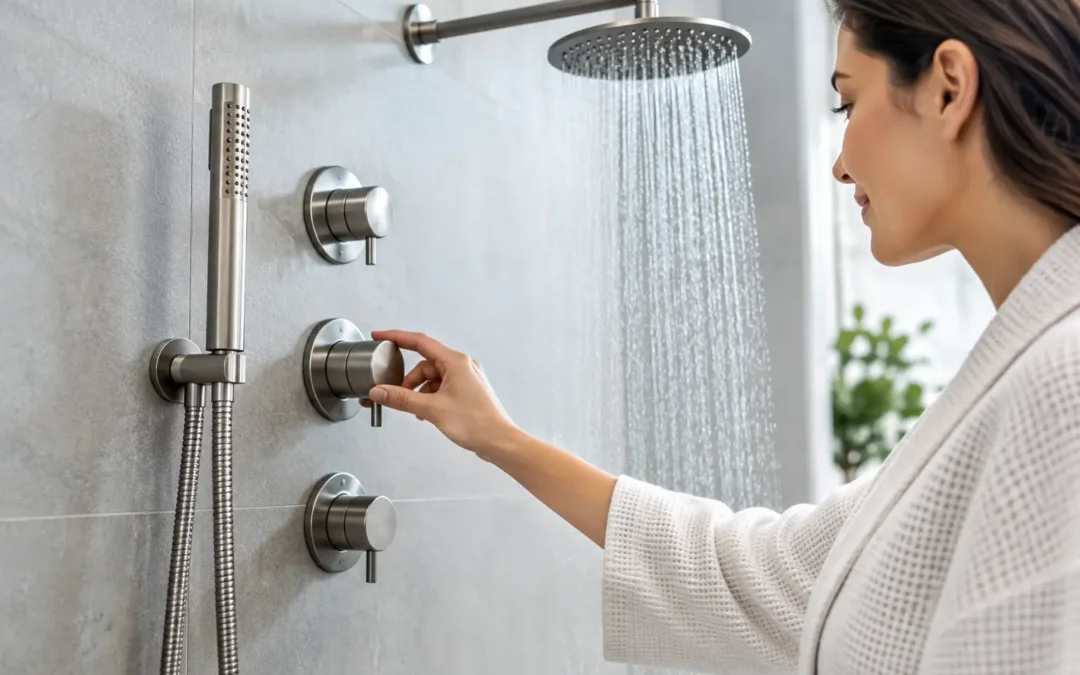
A single-outlet shower valve operates one water outlet at a time, such as a fixed shower head or a handset. This can be a clean, cost-conscious choice for a straightforward shower arrangement. A two-outlet valve lets you switch between two functions, most commonly a ceiling or wall-mounted shower head and a separate hand shower. Three-outlet controls can accommodate additional functions, such as body jets or a bath filler, though they are best reserved for layouts where those features will genuinely be used.
It is tempting to add every available shower function during the design stage. However, more outlets mean more components, more planning and usually a higher overall cost. A well-positioned handset alongside a quality overhead shower often provides all the flexibility most households need.
How to choose shower controls for your water system
The most attractive valve will not perform properly if it is incompatible with your home’s water pressure and hot-water arrangement. This is why shower controls should be considered alongside the wider bathroom design, rather than selected as a final decorative detail.
Homes in Kent may have a combi boiler, an unvented cylinder, a traditional gravity-fed system with tanks, or a system supported by a pump. These arrangements can deliver very different flow rates and pressures. Some shower valves are designed to work at low pressure, while others need higher pressure to provide the satisfying flow expected from a large drencher head.
A large overhead shower can be particularly demanding. It may look impressive in a showroom, but a generous spray plate paired with limited water pressure can produce a disappointing trickle. In this situation, a smaller shower head, a suitable pump where appropriate, or a different shower specification may offer a better result than simply choosing a more expensive control.
During a design consultation, the practical questions are straightforward: what system do you have, what pressure is available, how many bathrooms may be used at once, and do you want a shower and bath outlet to operate together? Honest answers to these questions protect both performance and budget.
Thermostatic or manual mixer controls?
For most family bathrooms and en-suites, thermostatic controls are the sensible choice. A thermostatic valve maintains the selected temperature even when water demand changes elsewhere in the home, such as when another tap is turned on. It also includes a safety stop, commonly set around 38°C, which reduces the risk of accidental scalding.
Manual mixer controls blend hot and cold water through the handle and can offer a simpler, often lower-cost solution. They are more dependent on stable supply conditions, however, and temperature can vary when pressure changes. They may be suitable in certain circumstances, but a thermostatic valve is generally the better long-term investment where comfort and safety are priorities.
Decide between concealed and exposed controls
Concealed shower controls sit behind the wall, leaving only the trim plate, handles and outlet visible. They create a neat, architectural look and work especially well in contemporary bathrooms, wet rooms and walk-in showers. With pipework hidden from view, tiles and wall finishes can take centre stage.
This approach does require careful planning before walls are closed and finishes are fitted. The valve body sits within the wall, so the chosen product must suit the wall depth and construction. Future servicing also needs consideration. Quality concealed valves are designed with serviceable working parts accessible from the front, but choosing a reputable, well-supported brassware range matters.
Exposed controls are mounted on the finished wall, with the valve and riser rail visible. They can be an excellent choice for traditional schemes, period homes and bathrooms where wall depth is limited. They are also often more straightforward to access and can provide a strong design feature in their own right, particularly in polished chrome, brushed brass or darker finishes.
Neither option is automatically better. Concealed controls favour a pared-back appearance, while exposed controls can be practical, characterful and better suited to particular room constructions.
Plan the control position before choosing the tiles
Control placement affects daily comfort more than many people expect. Ideally, you should be able to turn the shower on without standing directly beneath cold water. In a walk-in shower, controls are often placed just inside the opening or on a return wall, where they are easy to reach before stepping into the spray.
The position should also be convenient from outside the enclosure if a parent may need to assist a child, or if the shower is likely to be used by someone who benefits from added support. Avoid placing controls where the shower door, screen, shelving or a towel rail will make them awkward to access.
The height needs to suit the users and the chosen layout. There is no single perfect measurement, especially in homes where people are of very different heights. What matters is that the controls are comfortably reachable and look balanced with the shower head, niches, tiles and other brassware.
Match the controls to the rest of the bathroom
Shower controls are a small detail with a big visual role. Their finish should sit comfortably alongside basin taps, bath fillers, flush plates, accessories and lighting. Chrome remains a versatile, easy-to-coordinate choice, while brushed brass, brushed nickel, matt black and bronze can bring warmth or contrast to a scheme.
Consistency is helpful, but it does not mean every metal surface must be identical. A brushed brass shower control can work beautifully with a different cabinet handle finish if the overall palette feels deliberate. The key is to view samples together under the lighting planned for the room, rather than making decisions from isolated online images.
Handle style is equally relevant. Lever controls are often easier to operate with wet hands than very small knobs. Crosshead controls suit many classic bathrooms, while slim cylinders and flush plates tend to complement modern spaces. Consider cleaning too: detailed shapes and highly textured finishes may need more attention in hard-water areas.
Be realistic about cost and long-term value
Shower control pricing varies considerably. The valve itself is only part of the picture. The number of outlets, the chosen finish, concealed valve bodies, shower heads, ceiling arms, handsets, pipework requirements and any changes needed to support water pressure all influence the total cost.
This is one area where spending a little more on quality can make a meaningful difference. Controls are used every day, and poor-quality valves can lead to inconsistent temperature, stiff handles, fading finishes and difficulty sourcing replacement parts. Established manufacturers with available spares and clear warranties offer reassurance long after the bathroom is complete.
That said, the highest-priced option is not always the best value. A carefully chosen two-outlet thermostatic valve in a durable finish may give a better everyday result than a multi-function system that stretches the budget and offers little practical benefit.
Ask to see the controls in person
A showroom visit can make the decision much easier. Photographs do not tell you how a handle feels, whether a finish looks warm or cool in natural light, or how different control plates sit against tile samples. Seeing the products together also helps you understand the scale of the shower arrangement and identify details that may otherwise be missed.
At MBK Design Studio, bathroom choices are considered as part of the whole room – from water system compatibility and layout through to finishes, storage and the final visual balance. That joined-up approach is particularly valuable when a small control decision has implications behind the wall as well as in front of it.
Choose shower controls that feel simple to use, suit the plumbing you have and support the way your household lives. When those essentials are right, the first shower in your completed bathroom should feel exactly as good as you imagined during the planning stage.