The tile that looks perfect under showroom lighting can feel quite different once it is covering a compact family bathroom, meeting a wet shower area or sitting beside a period-style basin. This guide to bathroom tile choices is designed to help you look beyond the first impression and choose surfaces that suit your room, routines and budget for the long term.
Tiles carry a great deal of the visual weight in a bathroom. They set the tone for the whole scheme, affect how spacious the room feels and need to cope with water, cleaning products and daily wear. Getting the decision right is not simply about finding a colour you like. It is about balancing appearance, practicality and the quality of the finished detail.
Start with how the bathroom will be used
A downstairs cloakroom, a busy family bathroom and an en-suite have very different demands. In a cloakroom, wall tiles may be chosen primarily for decorative effect because the room sees little moisture. A family bathroom needs forgiving surfaces, safe flooring and grout that will still look good after years of splashes, bath toys and regular cleaning.
Think too about who uses the room. A walk-in shower used every morning benefits from a floor tile with dependable slip resistance. A guest en-suite may allow more freedom to choose a statement finish or a lighter-coloured grout that would be less practical in a high-traffic space. This early conversation prevents a beautiful idea becoming a daily frustration.
The condition of the room matters as well. Older Kent homes can have uneven walls, restricted layouts and awkward alcoves. Tile selection should support the design rather than make these features harder to manage. Large-format tiles, for example, can create a calm, contemporary look, but they require suitably prepared surfaces and careful planning around cuts.
Guide to bathroom tile choices: choose the material first
The material affects cost, maintenance, appearance and where a tile can safely be used. There is no universal best choice, but the distinctions are worth understanding before you fall for a particular pattern.
Porcelain: the dependable all-rounder
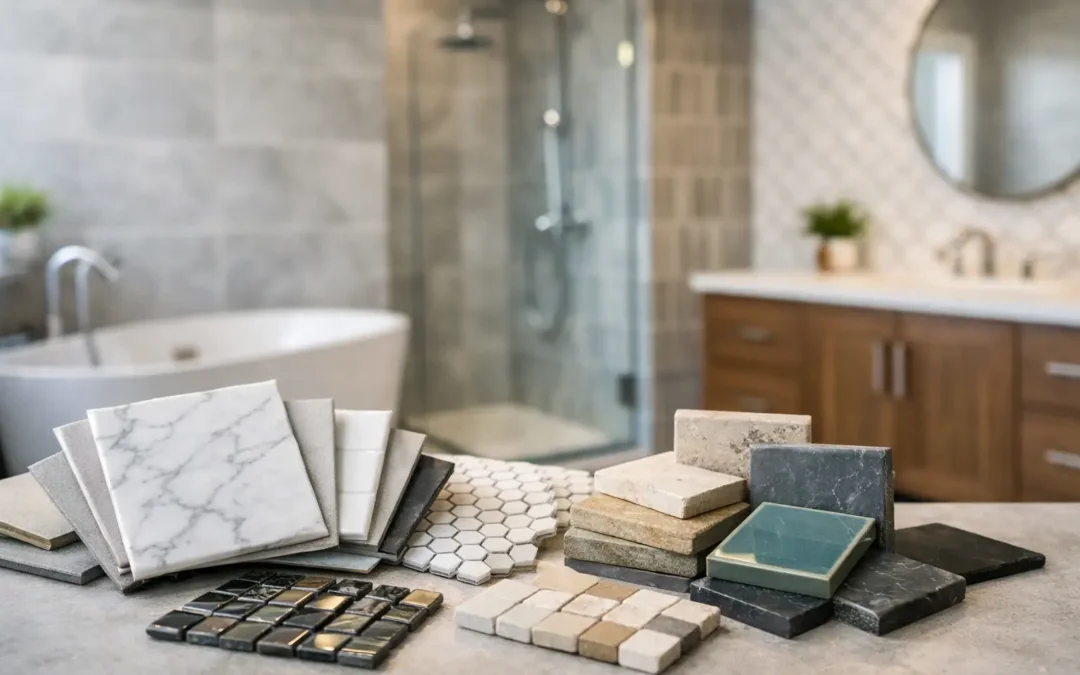
Porcelain is a popular choice for bathroom floors and walls because it is dense, low-porous and hard-wearing. It is available in an enormous range of designs, including convincing stone, concrete, timber and marble effects, without requiring the same level of care as the natural material.
For most households, porcelain offers a strong balance of performance and design flexibility. A matt stone-effect porcelain can bring warmth to a modern shower room, while a polished marble-effect option can give a more formal feel. The trade-off is that premium porcelain ranges, particularly large formats or textured finishes, can cost more and require skilled handling to achieve neat results.
Ceramic: ideal for many wall applications
Ceramic wall tiles are often a cost-effective and attractive choice. They are lighter and generally easier to cut than porcelain, with plenty of colours, shapes and decorative glazes available. Metro tiles, handmade-look finishes and small-format patterned ceramics can all introduce character without overwhelming the room.
Ceramic is not usually the first choice for bathroom floors, particularly in heavily used spaces, as it is less dense than porcelain. Used thoughtfully on walls, however, it can offer excellent value and a wide range of looks.
Natural stone: character with responsibility
Natural stone has variation that manufactured products can imitate but never fully reproduce. Marble, limestone, slate and travertine each bring their own texture and tonal movement, making every scheme individual. In the right traditional or luxurious setting, that natural character can be exceptional.
It also needs a realistic commitment to care. Many stones require sealing and periodic maintenance, and some are more vulnerable to staining, etching or changes in appearance over time. A stone floor can be a wonderful choice for homeowners who appreciate a living finish, but porcelain may be the wiser route for those wanting minimal upkeep.
Mosaics and feature tiles
Mosaics work particularly well in shower niches, on curved surfaces and as a defined feature behind a basin. Their smaller pieces and increased grout lines can also provide useful grip in certain wet areas. Use them with purpose rather than covering every surface. A carefully placed mosaic detail often has greater impact than a room competing with several patterns.
Consider size, shape and layout before ordering
Tile size changes the proportion of a room. Larger tiles mean fewer grout lines, which can make a bathroom feel more settled and spacious. They are not reserved for large rooms either. In a small en-suite, a 600 x 600 mm floor tile or rectangular wall tile can reduce visual interruption and create a cleaner finish.
That said, scale must be considered alongside the room layout. If a small space requires many narrow cuts around doors, pipe boxing or sanitaryware, the effect may be less elegant than expected. Smaller tiles can make these details easier to resolve and may better suit a period property or a room with plenty of angles.
Rectangular tiles can be laid horizontally to emphasise width, vertically to draw the eye upwards, or in a herringbone pattern for movement. Square tiles feel balanced and understated, while scallops, hexagons and kit-kat styles add personality. Patterned tiles need a quieter partner, usually on the surrounding walls or floor, so that the room still feels restful.
Before settling on a layout, consider where full tiles will begin and end. A well-planned design avoids tiny slivers at prominent edges and centres a feature where the eye naturally lands. These finishing decisions are often what separate a bathroom that looks good in photographs from one that feels properly considered in person.
Finish and slip resistance are not minor details
Gloss tiles reflect light and can brighten a darker bathroom, especially on walls. They are often easy to wipe clean, although water marks may show more readily in hard-water areas. Matt finishes offer a softer, more contemporary appearance and tend to disguise marks better, but textured matt tiles can need more attentive cleaning.
For floors, do not judge suitability by appearance alone. Ask about the tile’s slip-resistance rating and whether it is appropriate for a bathroom or shower area. A highly polished floor may look striking but can be less reassuring when wet. Conversely, a very textured tile can be safe underfoot yet harder to clean. The best option is usually one that offers sensible grip without an aggressively rough surface.
If you are continuing a floor into a walk-in shower, check that the chosen tile works with the required falls towards the drain. Smaller formats are often easier to use here because the additional joints allow the surface to follow the slope more naturally.
Grout, trims and colour deserve equal attention
Grout takes up more visual space than many people expect. Matching it closely to the tile gives a quieter, more continuous appearance. Contrasting grout highlights the shape and pattern of each tile, which can be effective with metro tiles or geometric designs but may feel busy over a large area.
Darker grout can be practical on floors and in busy shower zones, although it is not immune to limescale. Very pale grout can look fresh and refined but requires regular care to retain that appearance. Choosing a quality grout and the right cleaning routine is often more valuable than chasing the palest possible shade.
Trims should be chosen as part of the scheme, not as an afterthought. A slim metal trim in brushed brass, chrome, black or stainless steel can neatly frame an exposed tile edge and relate to taps, shower fittings or cabinet handles. In a more traditional bathroom, a glazed edge tile or a carefully mitred finish may better suit the design.
Set a realistic tile budget
The tile price is only one part of the finished cost. Larger tiles, intricate patterns, natural stone, mosaics and complex layouts can all increase the time and care required to create a precise finish. Extra material should also be allowed for cuts, pattern matching and contingencies, particularly where future repairs may be difficult to match.
It can be sensible to spend selectively. Many successful bathrooms pair a straightforward field tile with a more distinctive feature area, such as the shower wall or vanity backdrop. This keeps the overall scheme cohesive while allowing room in the budget for good brassware, lighting, furniture and the preparation that sits behind the visible finish.
See tiles in the room, not just in the showroom
A sample is essential, but it is only the beginning. Take it home, view it in daylight and artificial light, hold it against your paint, worktop or furniture finish, and look at it when wet if appropriate. Colours can shift significantly between a bright showroom and a north-facing bathroom.
At MBK Design Studio, seeing coordinating tiles, bathroom furniture and brassware together can help homeowners make decisions with greater confidence. It is also an opportunity to discuss the practical implications of a chosen format or finish before finalising the design.
The right tile choice should make everyday life easier while giving you pleasure whenever you enter the room. Choose the surface that fits the way you live, then give it the planning and detail it deserves.