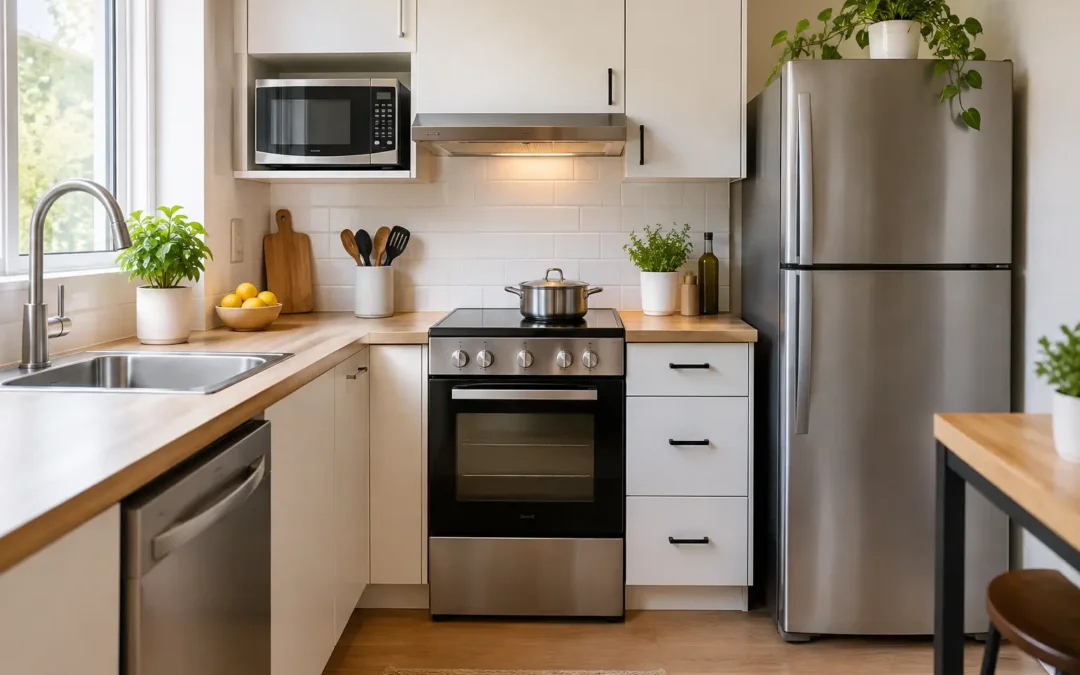
A small kitchen should not mean settling for a kitchen that feels compromised. The best appliances for small kitchens are not simply the narrowest models available. They are the appliances that suit how you cook, shop, entertain and manage everyday family life, while allowing the room to remain comfortable to use.
That distinction matters. A compact kitchen can work exceptionally well when every appliance earns its place, storage is designed around real routines, and doors, drawers and walkways have been properly considered from the outset.
Start with how you actually use the kitchen
Before comparing appliance specifications, think about the moments that place most demand on your kitchen. A couple who cook from fresh every evening may need a generous fridge and a capable oven, but could manage perfectly well with a slimline dishwasher. A busy family may value dishwasher capacity and flexible refrigeration over a second oven. Someone who entertains regularly may decide that a combination oven is useful, but only if there is enough worktop space left for serving food.
It is tempting to choose appliances individually because a particular model looks good or is on offer. This can lead to a kitchen that is technically well equipped but difficult to live with. In a smaller room, the overall layout is more valuable than any single feature.
A well-planned design considers appliance door swings, clear access to drawers, ventilation requirements and the space needed to prepare food beside the hob and sink. It also allows for the everyday items that tend to live on the worktop, such as a kettle, toaster, coffee machine or air fryer.
Best appliances for small kitchens: the key choices
A slimline dishwasher with realistic capacity
A 45cm slimline dishwasher is often one of the most sensible space-saving choices. It uses less cabinet width than a standard 60cm model while still offering enough room for many couples and smaller households. Modern slimline models can have adjustable racks, fold-down supports and programmes designed for lower loads, making them more flexible than their size suggests.
There is a trade-off. For a family kitchen where the dishwasher runs daily, a full-width model can be worth protecting in the plan. Reducing cupboard storage elsewhere may be preferable to repeatedly running a smaller dishwasher or leaving pans stacked by the sink. The right answer depends on your household, not on a blanket rule that smaller is always better.
An integrated dishwasher can help a compact kitchen feel calmer because it sits behind a matching door. In an open-plan room especially, this visual continuity can make a meaningful difference.
Refrigeration that supports your shopping habits
Fridge-freezer decisions are often made around available space rather than genuine need. An under-counter fridge may release visual space, particularly in a galley kitchen, but it can become frustrating if you regularly cook for several people or prefer a larger weekly shop.
A tall integrated fridge-freezer provides useful capacity within a single vertical run of cabinetry. It can create a neat, fitted appearance and makes good use of height. However, it should not be chosen without considering where the doors will open and whether a second person can move through the kitchen while they are in use.
For some homes, separate under-counter refrigeration and freezer drawers work well, particularly where the kitchen has a long run of base units and limited wall space. This arrangement can maintain open sightlines, though it usually offers less total volume and needs thoughtful organisation.
Whichever configuration you choose, look for adjustable shelves, accessible salad drawers and door storage that reflects what you buy. A slightly smaller appliance with a well-organised interior can be more practical than a larger one with wasted space.
A combination oven rather than multiple cooking zones
Cooking appliances are where compact kitchens can either become highly efficient or unnecessarily crowded. A built-in combination microwave oven can provide microwave, grill and oven functions in one appliance, making it a strong option where there is room for only one tall housing unit or a limited run of cabinetry.
A compact combination oven is particularly useful for households that want the flexibility of a second cooking space without giving up a large section of the kitchen. It can handle reheating, baking, grilling and smaller dishes while the main oven is in use.
The compromise is capacity. If you frequently cook large roasts, bake multiple trays or host extended family, a standard single oven may be the better primary appliance. In some designs, a full-sized oven below the worktop paired with a compact combination appliance in a tall unit gives the best balance, provided the room can accommodate both without sacrificing necessary storage.
An induction hob that preserves worktop space
Induction hobs are well suited to many smaller kitchens because they are flush or near-flush with the worktop and do not require the visual bulk of a freestanding cooker. When the hob is off, the surface can also function as additional preparation space, although hot pans and careful use still need to be considered.
A 60cm four-zone induction hob is often the most versatile choice, even in a compact room. It avoids the frustration of trying to manage several pans on an overly narrow surface. But a two-zone domino hob can be appropriate for a flat, a pied-à-terre or a household that cooks simply and values more uninterrupted worktop.
Do not overlook extraction. An induction hob with integrated extraction can remove the need for a separate hood and keep sightlines clear. It is not automatically the right choice, however. These systems need suitable ducting or recirculation arrangements, take up cupboard space below, and filters need regular care. A discreet canopy hood concealed within a wall cabinet may offer a more practical solution in some layouts.
A washer-dryer where utility space is limited
Where there is no separate utility room, a washer-dryer can prevent a small kitchen from being dominated by two large appliances. It is a sensible compromise for many households, particularly those with modest laundry loads and reliable places to air-dry occasional items.
The limitation is that washing and drying capacities are not usually the same. A machine may wash a full load but need a smaller load for drying, meaning some laundry has to be removed between cycles. Drying programmes can also take longer than expected. For a larger family, separate appliances elsewhere in the home may still offer a better long-term routine.
Small appliances deserve planned homes too
The appliances that cause the most clutter are often the smallest ones. A coffee machine, stand mixer, toaster and air fryer can quickly consume a limited worktop. Rather than treating them as an afterthought, include them in the kitchen brief from the beginning.
A breakfast cupboard with pocket or bi-fold doors can keep daily appliances accessible but out of sight when not in use. Deep drawers can store heavier machines safely, while a dedicated charging drawer can contain phones, tablets and cables. The goal is not to hide every useful object, but to leave enough clear surface for the kitchen to function properly.
Make the room work around the appliances
Appliance dimensions are not the same as the space an appliance needs. A fridge-freezer may fit within its housing, for example, but still require specified ventilation. A dishwasher and oven need clear access for loading. Cabinet doors should not collide with one another, and an open fridge should not block the only route through the room.
This is why choosing appliances early is so valuable. Exact models can be checked against the proposed cabinetry, rather than trying to force a late purchase into a finished design. It also gives you a clearer view of costs: premium compact appliances can be excellent, but the right investment is usually the one that improves daily use rather than adding features you will rarely use.
At MBK Design Studio, the most successful compact kitchens usually begin with an honest conversation about priorities. Some clients want as much storage as possible; others care most about cooking capability or a clean, uncluttered look. There is no single perfect appliance list, only a well-considered plan for the way you want to live.
A smaller kitchen can feel generous when it is designed around real life. Choose fewer compromises, not simply fewer appliances, and the result will be a room that supports every day with far less effort.