
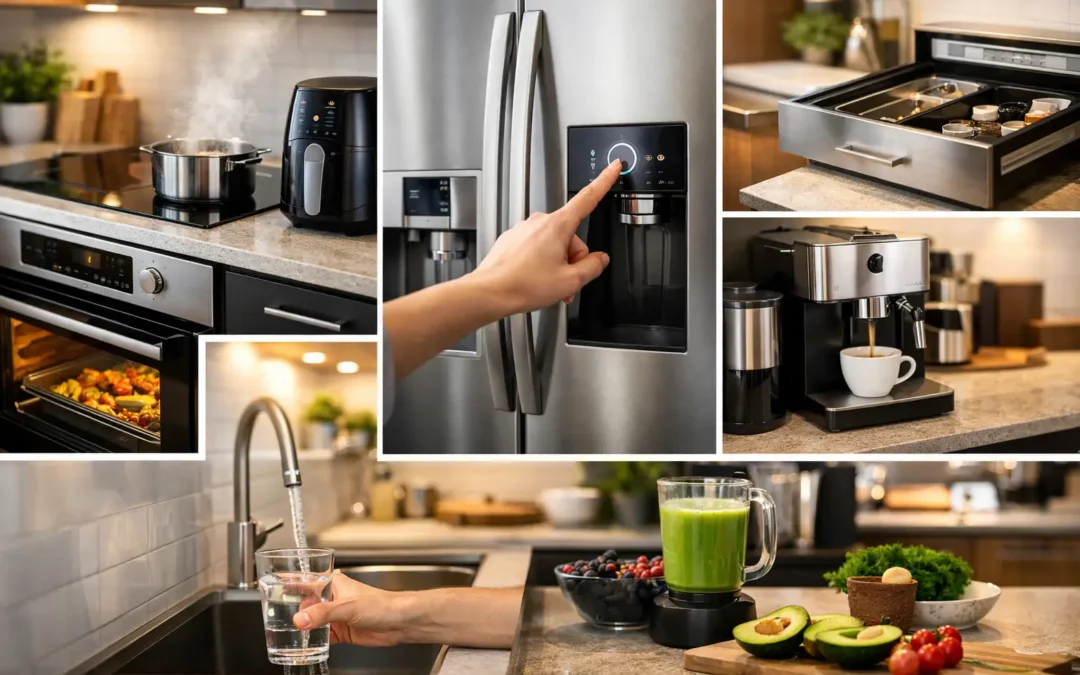
A kitchen can look beautifully finished on the day it is completed, but its appliances decide how it feels to live with six months later. The best kitchen appliance features are not necessarily the ones with the longest specification sheet. They are the features that make weekday dinners less rushed, keep noise down while people talk, and suit the way your household genuinely uses the room.
For a family kitchen in Maidstone or the surrounding Kent villages, that may mean a dishwasher that copes with a full day of cooking, refrigeration that accommodates a weekly shop, and an oven that can manage several dishes at different temperatures. For another household, it may be discreet appliances, a coffee machine ready for early starts, and excellent extraction in an open-plan room. The right choices begin with honest conversations about your routines, rather than selecting every available upgrade.
Best kitchen appliance features start with real routines
Before comparing brands, consider when your kitchen is busiest. Do two people cook at once? Is the kitchen also where homework, entertaining and working from home happen? Do you batch-cook, buy fresh little and often, or rely on quick meals between activities? These answers shape appliance decisions far more usefully than a showroom display alone.
A large single oven may be entirely sufficient for a couple who cook one main meal at a time. A family that hosts regularly may benefit more from two cooking zones – perhaps a full-height oven with a compact combination oven above it – than from one very sophisticated oven with functions they will rarely use. Likewise, a larger fridge freezer is valuable only if its internal layout suits the groceries you buy.
It is also worth deciding where you are prepared to compromise. Integrated appliances create a calm, furniture-led appearance, particularly in a traditional kitchen or a contemporary open-plan design. Freestanding models can offer greater capacity and sometimes a broader choice of finishes and specifications. Neither is automatically better; the best answer depends on the room, the budget and the priority you place on visual continuity.
Cooking features that earn their place
Flexible ovens beat novelty programmes
Modern ovens offer an extraordinary choice of settings, but the most useful features tend to be practical ones. A reliable fan oven, accurate temperature control, programmable cooking and easy-clean linings will serve most homes well. Telescopic runners are a small addition that makes checking a heavy roasting tin safer and easier, while a temperature probe can be genuinely useful for regular roasting or baking.
Steam-assisted cooking can help retain moisture in bread, vegetables and meat, but it is best chosen by people who will enjoy using it rather than because it sounds impressive. Similarly, a warming drawer is welcome when entertaining and plating several dishes, yet it may be difficult to justify in a compact kitchen where a useful cupboard or drawer would make more difference every day.
Combination microwave ovens are often a sensible space-saving choice. They can reheat, defrost and provide additional cooking capacity without taking up worktop space. However, their smaller cavity means they are usually an addition to a main oven, not a replacement for a household that regularly cooks larger meals.
Induction with the right controls
Induction hobs are popular for good reason. They heat quickly, respond precisely and leave less residual heat around the pan, which can make cleaning simpler. Features such as pan detection, booster zones and timers are genuinely helpful, particularly on busy evenings.
The details matter, though. Look at the size and position of the zones rather than simply the number of them. A flexible zone is useful for a griddle or large casserole dish, but only if that is part of your normal cooking. Touch controls can give a sleek finish, while physical knobs may be preferable for anyone who values immediate, tactile adjustment. Induction also requires compatible cookware, so factor replacement pans into the overall cost where necessary.
Gas remains a familiar preference for some cooks because the flame is visible and responsive. It does, however, create more surfaces to clean and places greater importance on effective ventilation. The design should support the cooking method you enjoy, not persuade you to change it unnecessarily.
Extraction should be quiet as well as powerful
In an open-plan kitchen, noisy extraction is one of the quickest ways to spoil a relaxed evening. Extraction performance matters, but so does the sound level at the settings you are likely to use. A hood that is highly effective only at an intrusive maximum speed may not be the most comfortable choice.
The appliance must also suit the layout. A ceiling unit, downdraft system or discreet integrated canopy can preserve sightlines, whereas a statement chimney hood may become an attractive focal point. Ducted extraction usually gives the strongest long-term results where the property allows for it; recirculating options can be appropriate where ducting is impractical, but filters require ongoing attention and replacement. This is a point worth considering early, because it affects cabinetry, ceiling space and the overall kitchen plan.
Cleaning and cooling features that reduce daily friction
A dishwasher should be selected for its loading arrangement as much as its stated place settings. Adjustable upper baskets, a dedicated cutlery tray and supports that fold down can make a real difference with pans, tall glasses and children’s drink bottles. An intensive lower-zone option helps if you cook from scratch frequently, while a quiet overnight cycle is particularly valuable in kitchens connected to living areas.
Auto-open drying is another feature that can be worthwhile. Opening the door slightly at the end of a cycle helps moisture escape, improving drying results without relying so heavily on heat. It is a modest detail, but it avoids the familiar moment of unloading damp plastic containers.
With refrigeration, focus on usable storage rather than headline litre capacity. Wide drawers, adjustable shelves and well-designed door storage help keep food visible, reducing waste as well as frustration. A dedicated freshness drawer can be beneficial for households buying plenty of produce, while a plumbed water dispenser may be less suitable if it complicates the layout or is unlikely to be used.
No-frost freezers save the chore of manual defrosting and are a sensible choice for many homes. If you like to freeze portions, look for drawers deep enough for them and consider whether a separate tall freezer would better support your habits than a standard fridge freezer. A kitchen design should make room for the way you shop, not force a weekly shop into unsuitable storage.
Consider the features beyond the appliance door
The most successful appliance choices work with the cabinetry, worktops and services around them. Ventilation gaps, door clearances, electrical loading and access for future maintenance should be planned properly from the outset. These less visible details protect both the finish of the kitchen and the performance of the appliance.
Energy labels are useful, but they should be interpreted alongside capacity and likely usage. A larger appliance with an efficient rating still uses more energy if it is half-empty or oversized for the household. Water use, standby consumption and the availability of eco cycles can be relevant too, especially for appliances used daily.
Smart controls divide opinion. Being able to check a dishwasher cycle or preheat an oven from a phone can be convenient, but connected features are not essential for a well-designed kitchen. Choose them when they solve a particular problem, such as managing a busy household schedule, rather than as a substitute for dependable core performance.
At MBK Design Studio, appliance selection is considered alongside the entire kitchen rather than as an afterthought. That allows the proportions, storage, ventilation and day-to-day workflow to be assessed together, helping avoid expensive changes later in the project.
Where it pays to spend, and where it may not
Budgets are rarely unlimited, so it is sensible to place investment where you will notice it most. In many kitchens, that means dependable cooking performance, effective quiet extraction and a dishwasher with a layout that makes loading easy. These are appliances used frequently, often at the busiest moments of the day.
Less-used specialist functions may be better treated as optional. A built-in coffee machine can be a pleasure for committed coffee drinkers, but a quality worktop machine may make more sense for others. Wine coolers, vacuum drawers and steam ovens can all be excellent additions when they support established habits, yet they should not displace essential storage or strain the budget for the sake of a trend.
Ask to see appliances operating where possible. Open the doors, test the racks, consider how high the oven will sit, and imagine unloading shopping into the fridge. A feature that sounds appealing on paper is only worthwhile if it feels intuitive when you use it.
The best choice is usually the appliance that quietly makes your kitchen easier to enjoy every day. Start with your routines, give priority to reliable essentials, and allow the finer features to reflect the way you want to live in the finished space.