A kitchen door is not simply a finish chosen near the end of a project. It sets the character of the whole room, influences how it feels to use every day and can affect the detail required in the overall budget. When weighing up handleless versus shaker, the right answer is rarely about following a trend. It is about choosing a style that suits your home, your routines and the level of detail you will still appreciate years from now.
Handleless versus shaker: the essential difference
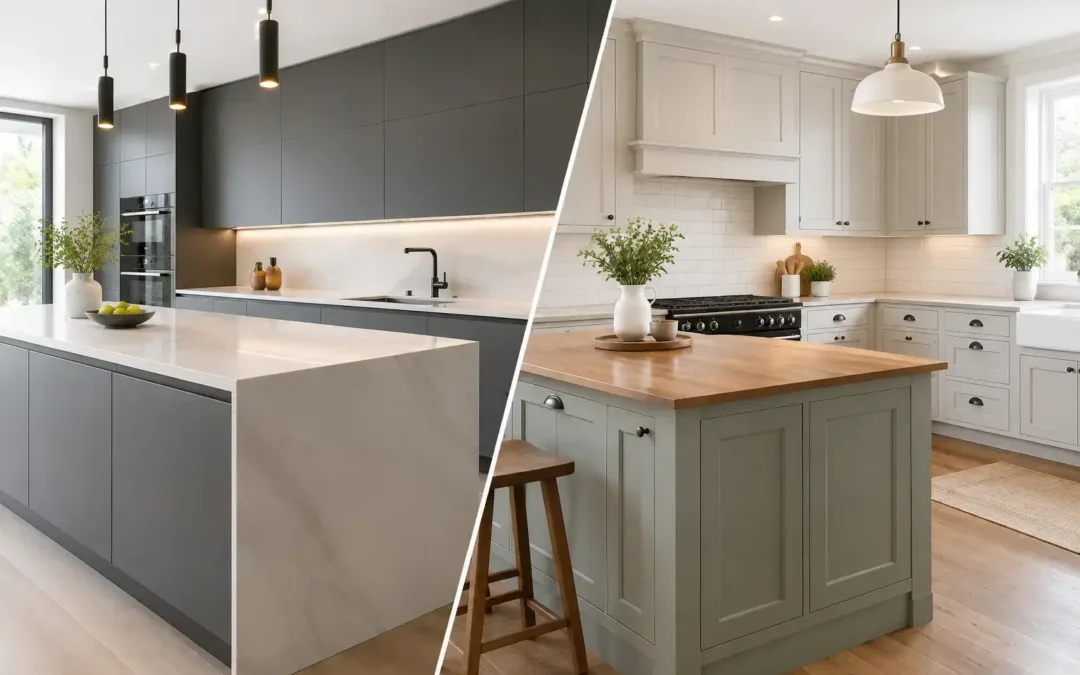
A handleless kitchen uses integrated channels, recessed grips, push-to-open mechanisms or profiled door edges instead of externally fitted handles. The result is a clean run of cabinetry with few visual interruptions. It is often associated with contemporary homes, but can work just as successfully in a period property when the colours, worktops and proportions are carefully considered.
A shaker kitchen has a framed door, traditionally with a recessed central panel. It has more shape and shadow than a flat-fronted kitchen, giving it a familiar, crafted appearance. Shaker doors can be paired with simple knobs, cup handles or more contemporary bar handles, making the style far more adaptable than many homeowners initially expect.
Neither option is inherently better made or more practical. Quality comes down to the cabinet construction, door finish, hardware, planning and fitting standards. The decision is primarily one of character, then practicality.
Choose the feeling you want the room to have
Handleless cabinetry creates a calm, architectural look. With no projecting handles, it allows the eye to travel across long banks of storage, particularly in open-plan rooms where the kitchen is visible from a dining or living area. It can make compact kitchens feel less busy and helps larger spaces feel deliberate rather than over-furnished.
Shaker cabinetry brings more texture and warmth. The framed detail gives each unit a presence, which can make a kitchen feel welcoming in family homes and properties with original features. Painted shaker doors in soft neutrals, deep greens, blue-greys or warmer off-whites remain popular because they sit comfortably alongside timber, stone and traditional flooring.
There is an important middle ground. A narrow-frame shaker door with restrained handles can feel fresh and tailored rather than overtly traditional. Equally, a handleless kitchen in a matt painted finish, with natural timber accents and softer lighting, need not feel stark. The surrounding choices matter as much as the door itself.
Think beyond the showroom display
Showroom displays are useful because they let you see door profiles, colours and handles at full scale. However, it is worth picturing the style in your own home. Consider ceiling height, natural light, existing flooring, the age of the property and whether the kitchen opens directly into another room.
A bold handleless scheme may be exactly right for a light-filled extension with large glazing. In a cottage or a home with more traditional joinery, shaker may create a more natural connection. That does not mean a modern kitchen cannot work in an older property. It simply needs enough warmth and considered detailing to look intentional.
Everyday use: where the practical differences appear
The most common question is whether handleless doors are harder to live with. The honest answer is that it depends on the type of handleless system chosen and how your household uses the kitchen.
Integrated rail systems place a recessed channel between drawers and doors. They are discreet and easy to grip, but the channel itself will need regular wiping, particularly near the hob or where children frequently open drawers. Fingerprints can also show more clearly on very dark, glossy or ultra-matt finishes. A good quality door finish makes a noticeable difference here.
Push-to-open mechanisms create the most uninterrupted look, but they are not always the best choice for every cabinet. They can be useful on selected doors, such as an appliance housing or a feature run of units, while drawers used throughout the day may be more satisfying with a profile or rail to grip. Opening a heavy drawer when your hands are wet or full can be easier with a physical point of contact.
Shaker kitchens have their own maintenance considerations. The joins and edges of the frame create more places for cooking residue and dust to settle than a flat door. They are straightforward to clean, but require a little more attention than a smooth slab front. External handles also need occasional tightening, especially on busy drawers.
For many families, handles are intuitive. Guests know where to pull, children can open a drawer easily and the kitchen is comfortable to use while cooking. On the other hand, handles project into the room. In a tight galley kitchen or a narrow walkway, choosing a compact handle or a handleless design can reduce the chance of catching clothing as you pass.
Cost is about more than the door style
It is tempting to assume that shaker is always less expensive and handleless is always more costly. Sometimes that is true, but it is not a reliable rule.
Price varies according to the door material and finish, cabinet specification, drawer systems, internal storage, worktops, appliances and the level of bespoke sizing required. A simple foil-wrapped shaker door may cost less than a painted handleless option, while a premium painted shaker kitchen with solid timber details and distinctive handles can exceed the cost of a straightforward handleless scheme.
Handleless kitchens may include additional cost for rails, profiles, colour-matched channel trims and specialist mechanisms. Shaker kitchens need handles or knobs, which vary greatly in price and quantity. A kitchen with thirty doors and drawers can require a significant number of handles, so the chosen design is not a minor detail.
It is also sensible to look at the whole project rather than reducing the decision to a door price. A layout that improves storage, circulation and worktop space will add more long-term value to daily life than choosing a style simply because it appears cheaper at first glance.
Which style lasts best?
Both can have longevity, but in different ways. Shaker has a well-established appeal that is unlikely to look out of place. It can be refreshed over time with new handles, a change of wall colour, different lighting or replacement worktops. If you enjoy updating your home gradually, that flexibility is appealing.
Handleless kitchens are less tied to decorative hardware, so their appeal relies on proportion, finish and the quality of the details. A well-designed handleless kitchen in a restrained colour will usually age well because it avoids novelty. Very high-gloss finishes, strong contrasting trims or heavily trend-led colours may feel more date-specific than the absence of handles itself.
For resale, it is better to aim for quality and cohesion than to second-guess every future buyer. A kitchen that suits the property, is planned properly and has durable materials will be more persuasive than one selected solely for broad appeal.
A useful way to make the decision
Start with how you want the room to feel when it is quiet and tidy. If you picture clean horizontal lines, large areas of uninterrupted cabinetry and a contemporary connection to the rest of an open-plan space, handleless may be the better direction. If you want character, softness and a style that works naturally with layered materials and classic details, shaker may feel more at home.
Then test both options properly. Open drawers, stand at the worktop, look along a run of tall units and imagine cooking on a busy weekday evening. Ask to see the actual finish under different lighting, not just a small colour chip. A door that looks perfect under showroom lighting can appear quite different in a north-facing kitchen or beside existing timber flooring.
At MBK Design Studio, these decisions are discussed alongside layout, storage, worktops and the wider home, rather than in isolation. That is often where a clear preference emerges: not from a photograph, but from seeing how every element will work together.
The best kitchen is the one that still feels right after the novelty has passed. Choose the door style that reflects your home and makes everyday tasks feel easier, then give it the quality of planning and detailing it deserves.