
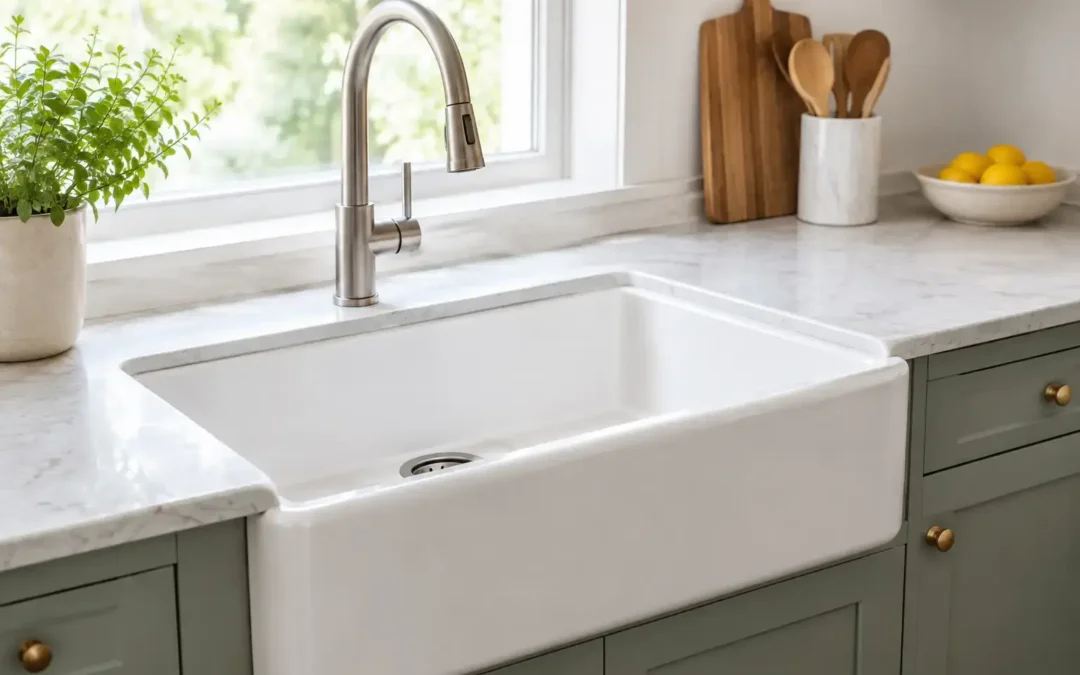
A sink is one of the hardest-working parts of any kitchen. It deals with hot pans, daily washing-up, food preparation and the occasional dropped glass, all while sitting in clear view on the worktop. This ceramic sink review looks beyond the appealing glossy finish to help you decide whether ceramic is the right long-term choice for your home.
For many homeowners, a ceramic sink brings a reassuring sense of permanence. It works particularly well in traditional kitchens, country-inspired schemes and Shaker designs, but the right model can look equally at home beside handleless cabinetry and a crisp quartz worktop. The decision is less about whether ceramic is fashionable and more about how you use your kitchen, the space available and the practical details behind the finished look.
Ceramic Sink Review: The Main Benefits
Ceramic sinks are valued for their smooth glazed surface, substantial feel and enduring appearance. Quality models are made from fired clay with a hard glaze that resists everyday staining, making them a practical choice for busy family kitchens. Tea, coffee, fruit juices and common cooking ingredients are generally easy to remove before they have a chance to mark the surface.
Their colour consistency is another advantage. A white ceramic sink can provide a clean focal point without competing with cabinetry, tiles or a patterned worktop. It also reflects light well, which can help a smaller or darker kitchen feel brighter. While white remains the classic choice, selected ranges are available in softer neutral shades for homeowners who want a more considered, layered palette.
Ceramic is naturally resistant to heat in normal kitchen use. Draining pasta water, rinsing roasting trays or placing a warm pan in the bowl is unlikely to cause the concern that some composite materials can create. That said, no sink benefits from sudden extremes. It remains sensible to run some cold water when introducing very hot water, particularly in a cold kitchen during winter.
There is also a tactile quality that photographs rarely capture. A ceramic sink feels solid, smooth and considered. For a renovation intended to last for many years, that sense of quality can make a real difference to how the room feels every day.
The Trade-Offs Worth Considering
The honest answer is that ceramic is not the lowest-maintenance or most forgiving sink material in every situation. It is hard, but it is not indestructible. A heavy cast-iron pan, dropped with force onto an exposed edge, can chip the glaze. Small chips can often be professionally repaired, but they may remain visible on a highly polished white surface.
The material is also heavy. This matters most with Belfast and farmhouse-style sinks, which need suitable support within the cabinet arrangement. A well-planned kitchen design accounts for this from the outset, including the position of pipework, taps, worktop joins and adjacent appliances. Trying to make a large ceramic sink fit an unsuitable existing unit later can create avoidable complications and costs.
The glossy surface shows certain marks more readily than a darker composite bowl. Water spots, metal scuffs from pan bases and residue around the waste can be noticeable, especially in hard-water areas of Kent. These are usually surface marks rather than damage, but regular cleaning will keep the sink looking its best.
Finally, ceramic has a particular visual character. If your preferred kitchen is highly industrial, very dark or deliberately understated, a stainless-steel or granite composite sink may suit the scheme better. A ceramic model should feel like an intentional part of the design, not a traditional feature added by default.
Which Ceramic Sink Style Suits Your Kitchen?
The best style depends on your cabinetry, worktop material and how much preparation space you need. An inset ceramic sink sits into the worktop with a visible rim. It is a familiar, versatile option and works with many laminate, solid surface and stone worktops. The rim can make cleaning around the edge slightly more involved, but it is an excellent practical choice for many kitchens.
A Belfast sink has a deep bowl and exposed front, often becoming the centrepiece of the room. It suits period homes and classic kitchen designs beautifully, particularly when paired with timber-effect cabinetry, painted doors or a traditional bridge tap. Modern versions can also give a contemporary kitchen warmth and contrast. However, it uses more cabinet and worktop space than a standard inset sink, so its proportions need careful consideration in a compact kitchen.
Undermounted ceramic options provide a cleaner worktop line, especially with quartz, granite or solid surfaces. Crumbs and spills can be wiped directly into the bowl, and there is no raised rim interrupting the worktop. Not every ceramic sink is suitable for undermounting, and the worktop and fixing method must be specified correctly. This is one area where choosing the sink alongside the wider kitchen design is valuable.
Consider bowl configuration as carefully as the style. A large single bowl is excellent for oversized pans, roasting tins and baking trays. A one-and-a-half bowl gives useful separation for draining, rinsing or food preparation without demanding the width of a full double bowl. For households that frequently cook from scratch or wash up by hand, this small decision can have a surprisingly large impact on daily convenience.
Cleaning and Caring for a Ceramic Sink
Routine care is straightforward. A soft cloth or sponge, warm water and washing-up liquid will deal with most everyday grime. Drying the bowl after use reduces water spotting and limescale build-up, particularly if your water supply is hard.
For stubborn marks, use a non-abrasive cream cleaner suitable for ceramic surfaces, following the product directions. Avoid harsh scouring pads, steel wool and aggressive chemicals, which can dull the glaze over time. Dark marks caused by metal cookware are often superficial and can be lifted with a gentle ceramic-safe cleaner rather than vigorous scrubbing.
Do not treat a ceramic sink as a storage area for wet pans, cutlery or tins. Leaving metal objects in the bowl for long periods can encourage marks or rust staining. A protective sink grid can be worthwhile if you regularly wash heavy cookware, although some homeowners prefer the uninterrupted look of the bowl without one.
How Ceramic Compares With Other Sink Materials
Stainless steel remains popular because it is lighter, economical and forgiving if cookware is dropped into it. It can be the sensible choice for a utility room or a contemporary kitchen where practicality takes precedence. However, it scratches more visibly and can feel less substantial than ceramic.
Composite sinks, often made with granite particles and resin, offer a broad range of colours and a more muted finish. They are particularly effective when coordinating with darker worktops or modern cabinetry. Their resistance to scratches and stains can be excellent, although they may be less tolerant of intense heat and can require more care to prevent limescale from showing on darker shades.
Ceramic sits between these options as a material chosen as much for its appearance and feel as for its practical performance. It is not necessarily the best answer for every kitchen, but it is often the most satisfying choice when a homeowner wants a bright, timeless focal point and is prepared to treat it with sensible care.
Questions to Ask Before You Choose
Before committing to a ceramic sink, check the cabinet width, bowl depth and tap position. Deep bowls are useful, but they can affect the available height beneath the sink for waste pipes, water filters or pull-out storage. If you are tall, also consider the working height of the sink and worktop together, as a very deep bowl can feel less comfortable over long periods.
Think about your tap at the same time. A large Belfast sink can carry a statement tap well, while a compact inset bowl may need a more proportionate design. The tap reach should deliver water towards the centre of the bowl rather than constantly splashing against the back or front edge.
At MBK Design Studio, these details are considered as part of the wider kitchen plan, because the most attractive sink is only successful when it works naturally with the cabinetry, worktop and the way you live. A showroom visit can be especially useful here: seeing bowl depths, finishes and tap combinations in person is far more revealing than comparing product photographs.
A ceramic sink earns its place when it suits both the character of your kitchen and the rhythm of your household. Choose the size and style with care, allow for its weight and support requirements, and it can remain a quietly dependable part of your kitchen for many years.