
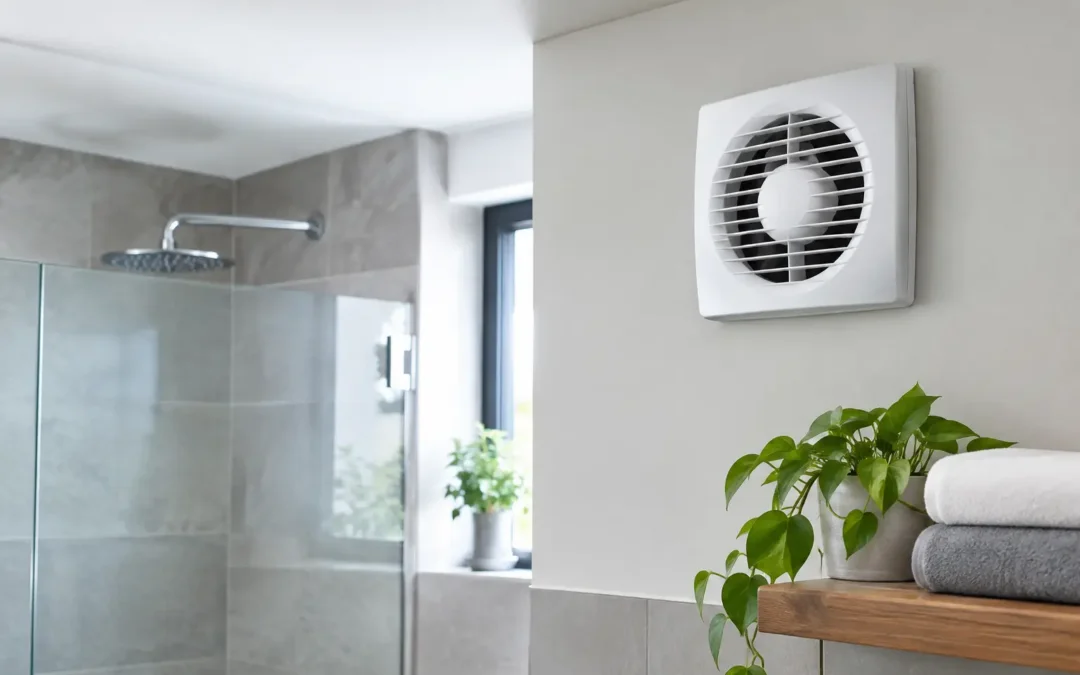
A beautiful new bathroom can quickly lose its appeal if the mirror stays steamed up, towels never seem to dry and black mould begins appearing around silicone joints. This bathroom extractor fan guide explains how to choose ventilation that protects the finishes you have invested in, without adding unnecessary noise or compromising the look of the room.
An extractor fan is not the most glamorous item on a bathroom specification, but it is one of the hardest-working. It removes moisture created by showers and baths before it can settle on walls, ceilings, cabinetry and cold surfaces. Getting the decision right at the design stage helps your bathroom feel fresher and stay in better condition for longer.
Why bathroom ventilation deserves proper attention
Bathrooms produce a surprising amount of warm, moist air in a short time. When that air meets a cooler tile, window, external wall or ceiling, it turns into condensation. Occasional condensation is normal, particularly in winter. Persistent condensation is different: it can encourage mould, damage paintwork, swell timber-based furniture and leave a musty smell that no amount of cleaning fully solves.
Opening a window helps, but it is not a dependable substitute for mechanical extraction. Windows are often kept shut for privacy, security, weather or warmth, and they do not consistently remove moisture from the source. A correctly specified fan gives the room a reliable route for humid air to leave.
For a full bathroom refurbishment, this is also a design issue. The fan position, duct route, external grille and control method all need considering alongside lighting, ceiling details, furniture and the shower layout. Leaving it until late in the project can mean more visible compromises.
Bathroom extractor fan guide: start with airflow
The most useful performance figure is airflow, usually shown in litres per second (l/s) or cubic metres per hour (m³/h). As a broad benchmark under current UK guidance, an intermittent extract fan in a bathroom is commonly expected to achieve at least 15 l/s, equivalent to 54 m³/h. A continuously running system has a lower continuous extract rate, commonly 8 l/s, because it operates all the time.
Those figures are a starting point rather than an automatic answer. A large family bathroom with a powerful shower, little natural ventilation and several regular users may benefit from a higher-capacity fan. A small cloakroom with a basin and WC has very different demands. Room volume, how the room is used, the length of ducting and the number of bends all affect the real-world result.
It is easy to focus on the number printed on the fan box. However, airflow can fall significantly when air must travel through a long duct run or several tight bends. A fan that appears powerful on paper may underperform if the ducting has been poorly planned. Where possible, use a short, direct route to the outside and avoid unnecessary restrictions.
Axial, centrifugal and inline fans
An axial fan is the familiar format often fitted through an external wall or ceiling. It can be a sensible choice where there is a short, straight route outdoors. They are compact and can be discreet, particularly when selected to coordinate with a simple ceiling or wall grille.
Centrifugal fans are better suited to more demanding duct routes because they maintain performance against greater resistance. They can be useful where the fan needs to move air through longer ducting, such as from an internal bathroom.
An inline fan sits within the loft space or duct run rather than in the bathroom ceiling itself. This can be an excellent choice for a quieter bathroom because the motor is positioned away from the room. It does require suitable access and careful planning, but for a principal bathroom or an en-suite close to a bedroom, the difference in perceived noise can be worthwhile.
Do not overlook noise levels
A fan that is technically effective but unpleasantly loud is more likely to be switched off or avoided. Noise is measured in decibels, shown as dB. Lower figures are generally quieter, but compare like for like: the stated noise level may be measured at a particular distance or airflow setting.
The quietest approach is not always the cheapest, particularly where an inline system and longer-quality ducting are needed. Still, the added comfort can make sense in a bathroom used early in the morning or late at night. In a family home, a quieter fan also makes the room feel more considered and less utilitarian.
Bear in mind that rattling grilles, loose ducting and restrictive flexi-duct can create noise even with a good fan. Sound performance comes from the complete arrangement, not the fan unit alone.
Choose controls that suit the household
The control method has a major effect on whether moisture is removed properly. A basic fan linked to the light switch is familiar and affordable, but it runs only while the light is on. If someone showers in daylight or turns the light off immediately afterwards, extraction may stop too soon.
A timer fan continues running after the light is switched off. This is often a practical middle ground, provided the overrun period is set sensibly. Fifteen to twenty minutes may suit many bathrooms, though the correct setting depends on the room and how much moisture is produced.
Humidity-sensing fans start automatically when the moisture level rises. They are useful for households where shower habits vary, or where people are unlikely to leave a fan running deliberately. The trade-off is that low-quality sensors can be over-sensitive or slow to respond, so product choice and set-up matter.
Continuous-running fans provide gentle extraction throughout the day, increasing speed when needed. They can be particularly effective in homes with recurring condensation concerns, but they need to be selected and commissioned carefully so they remain quiet and do not feel intrusive.
Plan the position, ducting and outside vent together
The fan should be located where it can capture humid air effectively, generally close to the shower or bath area while respecting electrical safety requirements. It should not be placed so close to an open window that replacement air simply short-circuits the extraction route.
The air must discharge outside, not into a loft, ceiling void or garage. Venting moist air into an enclosed space simply moves the condensation problem elsewhere. The external termination should also be positioned carefully, away from locations where expelled moist air could affect adjoining surfaces or re-enter the property.
Ducting deserves more attention than it often receives. Rigid ducting generally offers better airflow than long, sagging flexible duct. Insulated ducting can help reduce condensation forming inside the run where warm bathroom air travels through a cold loft. A professional bathroom plan considers these practical details before ceilings are closed and finishes are complete.
Understand the electrical and building requirements
Bathrooms are divided into electrical zones because water and electricity require particular care. The type of fan, its IP rating and its placement must be appropriate for the location. Some fans can be fitted within certain zones, while others must be positioned outside them. This is not an area for guesswork.
Ventilation work should also comply with relevant Building Regulations, including the ventilation standards within Approved Document F. Requirements can vary according to the nature of the project and the existing property, so the specification should be checked as part of the wider bathroom work. Proper commissioning matters too: a fan should be tested to confirm that it is achieving the intended extract rate, rather than simply turning on.
Match the fan to the bathroom you are creating
For a compact en-suite on an outside wall, a quiet axial timer or humidity fan may be all that is needed. For an internal family bathroom beneath a loft, an inline or centrifugal option may offer a more effective and quieter solution. In a period home, where cold external walls and limited opening windows can increase condensation risk, consistent extraction becomes even more valuable.
The visual finish matters as well. Modern ceiling grilles can be subtle and unobtrusive, while some designs allow a more coordinated appearance with lighting and ceiling finishes. There is no benefit in creating a carefully balanced scheme only to add an oversized, conspicuous grille as an afterthought.
At MBK Design Studio, ventilation is considered as part of the whole bathroom, alongside layout, storage, lighting and the materials that need protecting. That joined-up thinking helps avoid costly changes later and supports a bathroom that looks as good in years to come as it does on completion.
If you are planning a bathroom refurbishment, treat the extractor fan as a small decision with a large effect. A well-chosen, correctly planned fan will quietly protect the room every day, leaving you free to enjoy the design rather than manage the moisture.