
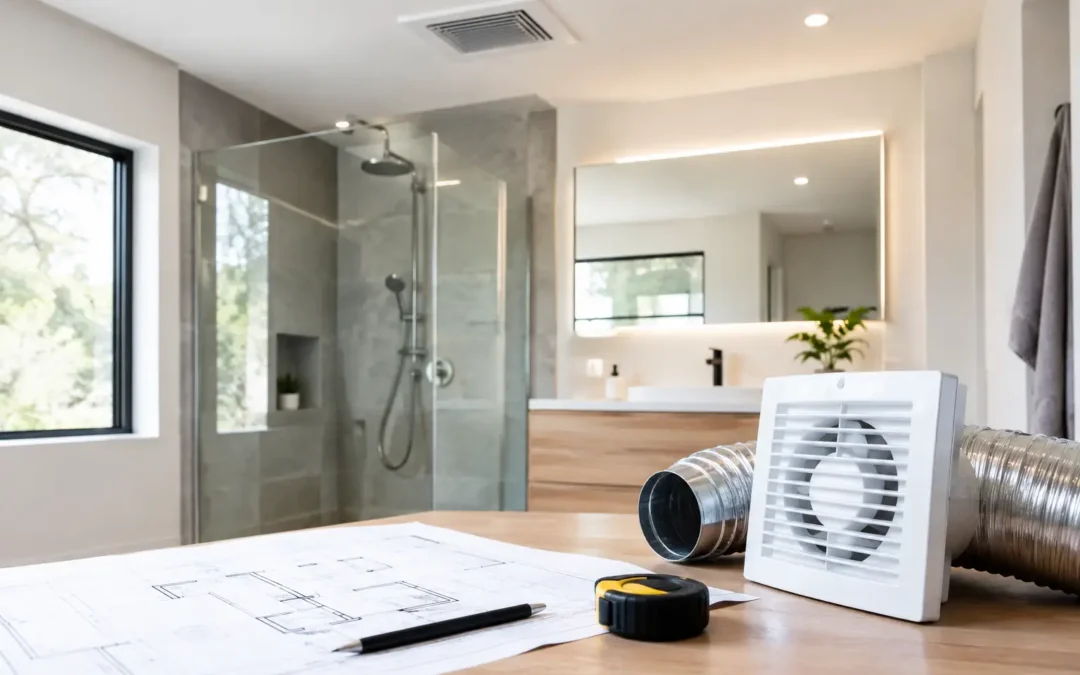
A beautiful new bathroom can lose its appeal quickly if the mirror stays misted, towels never properly dry and mould begins appearing around silicone seals. This bathroom ventilation planning guide explains the decisions worth making before tiles, furniture and fittings are chosen, so your finished room looks after both your comfort and your investment.
Ventilation is not an add-on to resolve at the end of a refurbishment. It affects the layout, the ceiling design, electrical planning, noise levels and even the long-term condition of the room. Getting it right is usually straightforward when it is considered early. Getting it wrong can mean a fan that is loud, ineffective or difficult to put right once the room is complete.
Why bathroom ventilation deserves early planning
Every shower, bath and sink adds moisture to the air. In a small, enclosed bathroom, that moisture settles first on cooler surfaces: mirrors, windows, ceilings, walls and fittings. Over time, persistent condensation can encourage mould growth, damage paint finishes and leave timber or cabinetry vulnerable to swelling.
An opening window is useful, but it is not a dependable replacement for mechanical extraction. It relies on someone being at home, willing to open it and able to leave it open long enough, which is rarely practical on a cold Kent morning. A properly specified extractor fan removes moisture at source and continues working after the bathroom has been used.
This matters even more in modernised homes where draughts have been reduced through better windows, insulation and sealing. A more energy-efficient home needs intentional airflow rather than relying on gaps around the building.
Bathroom ventilation planning guide: begin with the room
The right system depends on how the bathroom is used, not simply its floor area. A compact en-suite with a daily shower has a different demand from a family bathroom used for baths, showers and busy morning routines. A room without a window needs particularly careful attention, while a bathroom with a long route to an outside wall may need a different type of fan.
Start by considering where steam is created and where it can travel. The fan should usually be positioned close to the shower or bath area, where it can capture moist air before it spreads through the room. It should not be so close that electrical safety requirements become an issue. Your bathroom designer and qualified electrician can coordinate the layout with the applicable bathroom zones and current regulations.
Also consider the room’s make-up air. An extractor cannot remove air effectively if replacement air cannot enter. A suitable gap beneath the door, or another planned air path, allows fresh air to move into the bathroom as humid air is extracted. It is a small detail that has a significant effect on performance.
Understand the required extraction rate
In England, Building Regulations Part F sets minimum extraction standards for bathrooms. As a general guide, an intermittently operated fan in a bathroom is commonly required to extract at least 15 litres per second. A continuous system generally has a lower minimum rate for the room, commonly 8 litres per second, because it runs constantly.
These figures are a starting point, not a reason to choose the cheapest fan with a matching number on its box. The stated airflow may be measured in ideal conditions, with no long duct run or bends. Once air has to travel through ducting, performance can reduce. Your final specification should account for the room, route and system type, with compliance confirmed for the individual project.
Choose the fan type to suit the duct route
A conventional axial fan can be a sensible choice where there is a short, straight route through an external wall. It is often compact and cost-effective, but it can struggle when ducting is long or changes direction several times.
For a bathroom in the middle of a house, or one venting through a loft space to an external wall or roof outlet, an inline or mixed-flow fan is often the better choice. These systems are designed to deal with greater resistance and can be located away from the bathroom ceiling. That can make them noticeably quieter in the room, although access for future servicing must be planned.
There is a trade-off. A more capable fan and better ducting may cost more at the outset, but an undersized unit that leaves a new bathroom damp is a false economy. This is one area where the lowest initial price rarely tells the whole story.
Plan the ducting, not just the fan
The duct route is where many otherwise good ventilation plans fall down. Air moves best through short, smooth, straight ducting. Every unnecessary bend, crushed section or reduction in diameter creates resistance, making the fan work harder and move less air.
Rigid or semi-rigid ducting is generally preferable to flexible ducting for longer runs because its inner surface is smoother and it is less likely to sag. Where ducting passes through an unheated loft, insulating it can help prevent condensation forming inside the duct. That moisture should not be allowed to drip back into the fan or ceiling void.
The external termination also needs thought. It must vent outdoors rather than into a loft, ceiling void or garage. A discreet external grille or roof outlet should be selected and positioned to protect against weather while allowing air to escape freely. It should remain accessible for occasional cleaning, as lint and dust can collect over time.
If your proposed design includes a lowered ceiling, fitted storage or feature lighting, decide the ventilation route before those details are finalised. It is far easier to conceal ductwork neatly during a refurbishment than to alter a finished ceiling later.
Controls that match real life
A basic fan linked to the bathroom light is familiar, but it may stop before the moisture has cleared. A timer overrun allows the fan to continue for a set period after the light is switched off. For many households, this is a practical and reliable solution.
A humidistat control responds to moisture levels, switching the fan on when humidity rises and running until it falls. This can be especially helpful where different people use the room at different times, or where a bathroom is used for showering but the light is not always left on. However, it needs sensible set-up. If the threshold is too sensitive, the fan may run more often than expected; if it is set too high, it may not react soon enough.
Continuous extract systems offer a low, constant level of ventilation and can increase speed when the bathroom is in use. They can work well in carefully planned homes, but the background sound, controls and whole-house ventilation approach need to be considered together. There is no single best answer. The best choice is the one that suits your property, household and planned duct route.
Do not overlook noise and maintenance
Noise is one of the main reasons homeowners stop using an extractor fan as intended. Look beyond marketing descriptions such as “quiet” and compare the stated sound level in decibels. Fan location, duct resistance and the quality of the installation all influence what you will hear in practice.
A fan that is slightly more expensive but quiet enough to run without becoming irritating is often the better long-term decision. This is particularly relevant for en-suites adjoining bedrooms, where early-morning use should not disturb the household.
Ventilation also needs simple ongoing care. The internal cover should be cleaned periodically, and external grilles checked for dust or obstruction. If the fan becomes louder, less effective or continues to leave condensation after normal use, it is worth investigating promptly rather than waiting for mould or damage to develop.
Coordinate ventilation with the wider bathroom design
The strongest bathroom schemes bring practical elements together rather than treating them as separate decisions. Ceiling height can affect where ducting runs. A large walk-in shower may generate more steam than a compact enclosure. Timber-effect furniture, painted finishes and premium brassware all benefit from a room that dries efficiently.
At MBK Design Studio, ventilation is considered as part of the wider bathroom conversation: how the room will look, how it will be used and how it will perform for years to come. Discussing it during the design stage gives you more options for discreet grilles, sensible routes and controls that fit your day-to-day routine.
A well-planned extractor is rarely the feature people notice first in a new bathroom. That is exactly the point. When the room clears quickly, feels fresh and protects the finishes you have chosen, ventilation is quietly doing one of the most valuable jobs in the space.