
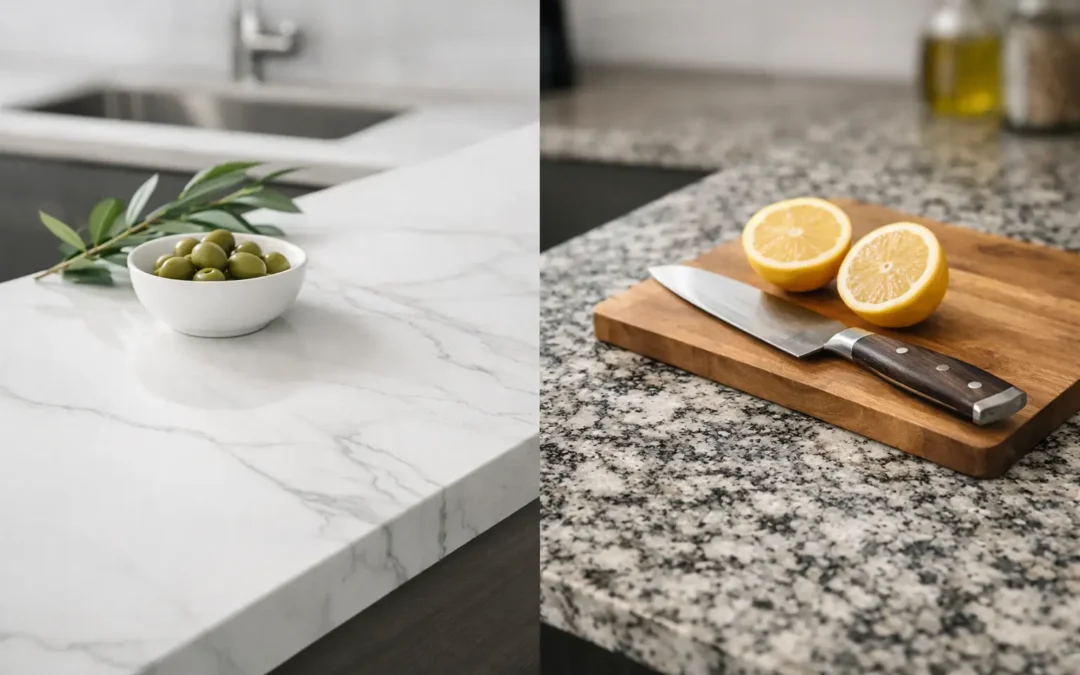
A kitchen worktop has to do far more than look attractive under showroom lighting. It needs to cope with hot pans, family breakfasts, food preparation, spills and the everyday knocks of a busy home. This porcelain granite comparison looks beyond first impressions, helping you decide which surface suits your kitchen, lifestyle and budget.
Both materials can create an impressive, long-lasting kitchen. The right choice is rarely about one being universally better than the other. It comes down to the look you want, how you use the room and how much natural variation you are comfortable embracing.
Porcelain vs granite: what are you choosing?
Granite is a natural stone, formed over millions of years and cut into slabs for use as worktops. Every slab has its own mineral pattern, movement and colour variation. Some granites are calm and consistent; others have bold veins, flecks and crystalline detail. That individuality is a major part of their appeal.
Porcelain worktops are manufactured from refined clays, minerals and pigments, pressed and fired at extremely high temperatures. This process produces a dense, hard surface. Modern porcelain can faithfully reproduce the appearance of marble, concrete, metal, timber and natural stone, while also being available in plain, contemporary colours.
In practical terms, granite brings the character of nature into the kitchen. Porcelain provides greater control over the final appearance. For a homeowner who has fallen in love with a particular granite slab, there is no substitute for seeing that exact piece. For someone seeking a consistent veined finish across a large island and surrounding worktops, porcelain can be easier to plan with.
Appearance and design flexibility
A granite worktop can make a kitchen feel established and substantial. It works particularly well alongside painted cabinetry, timber details and traditional design features, although the right finish can look equally at home in a clean-lined contemporary space. Polished granite reflects light and shows the depth of the stone, while honed finishes offer a softer, more understated appearance.
Porcelain is exceptionally versatile from a design point of view. It can deliver the pale marble look many homeowners love without requiring a natural marble surface. It is also available in dramatic dark stone effects, warm neutral tones and industrial-inspired finishes. Large-format porcelain slabs can create a striking uninterrupted look on an island, with carefully planned matching splashbacks or feature panels.
There is a trade-off. Some porcelain designs are remarkably convincing, but they do not have the same natural depth as a real granite slab when viewed closely. Conversely, granite’s natural movement means that samples should be treated as a guide rather than a guarantee. A small swatch cannot show the full personality of a slab.
For this reason, showroom selection matters. Looking at larger samples, cabinet door colours, handles, flooring and lighting together gives a far more reliable impression than choosing a surface from a photograph.
The porcelain granite comparison on daily durability
Both porcelain and granite are durable choices for a well-designed kitchen, but they perform differently in use.
Porcelain is highly resistant to stains, heat and scratching. Its low porosity means that common kitchen spills such as wine, coffee, oil and acidic foods are unlikely to penetrate the surface. It is also colour-stable, making it a good option for bright rooms with plenty of natural light. You can place a hot pan on porcelain, although using a trivet remains sensible practice for protecting both the worktop and any nearby joins.
Granite is also extremely hard-wearing and heat-resistant. It has proved itself in kitchens for decades. However, because it is a natural material, its porosity varies by stone type and finish. A quality granite worktop is normally sealed to help resist staining, and this protection may need renewing over time. With sensible care, granite can remain beautiful for many years.
Neither material is indestructible. Porcelain is very hard but can be vulnerable to chipping at exposed edges or corners if it receives a sharp impact. Granite can chip too, particularly around cut-outs, and heavy impacts may cause damage. The quality of templating, fabrication and fitting is therefore just as important as the material itself.
Cleaning and ongoing care
For households wanting the simplest routine, porcelain has a clear advantage. Warm water, a soft cloth and a suitable mild cleaner will handle most day-to-day cleaning. Its non-porous nature means there is no routine sealing requirement.
Granite is still straightforward to look after, but it benefits from a little more attention. Wipe spills promptly, particularly highly pigmented or acidic liquids, and avoid harsh chemicals that can affect the sealant or surface finish. The required frequency of resealing depends on the specific granite and how the kitchen is used. It is not an everyday concern, but it is worth factoring into the long-term ownership decision.
Avoid using abrasive scouring pads on either surface. They are unnecessary and may dull a polished finish or leave marks that are harder to remove than the original spill.
Thickness, edges and the details that affect the final look
The visual effect of a worktop is influenced by more than its colour. Granite is often selected in thicker slabs or built up at the edges to create a substantial, classic profile. It can be shaped with a variety of edge details, from a simple softened edge to a more decorative profile suited to a traditional kitchen.
Porcelain is commonly thinner, which supports its crisp, architectural appearance. It works beautifully with slim worktop lines and modern furniture, and it can be used vertically for splashbacks or cladding where a coordinated finish is desired. Edge detailing is more limited than with granite, but that restraint is often exactly what makes porcelain look so refined.
The choice can also affect practical design decisions. Undermounted sinks, draining grooves, upstands, splashbacks and waterfall ends all require detailed consideration. Not every feature is appropriate for every material or slab design, so it is best to discuss these early rather than treating them as finishing touches.
Cost: why quotes can vary
It is understandable to ask whether porcelain or granite is cheaper, but a simple material-for-material comparison can be misleading. The final price depends on the slab selected, thickness, worktop layout, number of joins, cut-outs, edge treatment, access to the property and the amount of fabrication required.
A straightforward run of worktop with a standard sink and hob cut-out will be priced very differently from a large island with waterfall panels, a recessed drainer and a matching full-height splashback. Some premium porcelain designs cost more than entry-level granite, while rare or heavily patterned granite can sit at the higher end of the market.
The most useful approach is to set an overall kitchen budget, then compare like-for-like proposals based on the same layout and specification. A clear quotation should explain what has been allowed for, rather than leaving important details to appear later as extras.
Which worktop is right for your kitchen?
Choose porcelain if you want a low-maintenance surface with excellent stain resistance, a slim modern profile or a very controlled decorative finish. It is particularly appealing for busy kitchens where easy cleaning is high on the list, and for designs that carry the worktop material up the wall as a splashback.
Choose granite if you value authentic natural stone, depth of colour and a one-of-a-kind surface. It is a strong choice for homeowners who appreciate natural variation and are happy to follow a simple care routine to preserve the finish.
There are also kitchens where the answer is not obvious. A modern painted shaker kitchen can look superb with either a softly veined porcelain or a honed granite. A bold contemporary kitchen may suit a dark granite with striking mineral detail just as well as a matte porcelain. Cabinet colour, room light and the scale of the worktop all influence the result.
At MBK Design Studio, the most successful kitchen projects begin by understanding how a household actually lives, not by pushing a surface that happens to be fashionable. Bring together your preferred door style, colours and practical requirements, then view the worktop options in person. The material that feels right in your hands and works confidently with the wider design is usually the one you will still be pleased to see every morning years from now.