A kitchen rarely feels right when it is designed around a label alone. “Modern” can look too stark in a period property, while “traditional” can feel heavy in a bright open-plan space. That is why mixing modern and traditional kitchen cabinets appeals to so many homeowners – it gives you room to create something that feels personal, practical and suited to the way you actually live.
Done well, this approach does not look confused or halfway finished. It looks considered. The key is knowing where to introduce contrast, where to keep continuity, and how to make every choice support the overall character of the room.
Why mixing modern and traditional kitchen cabinets works
The most successful kitchens tend to balance warmth with simplicity. Traditional cabinetry brings detail, texture and a sense of permanence. Modern cabinetry adds cleaner lines, easier visual flow and a fresher overall feel. Bringing the two together can soften the extremes of either style.
This is particularly useful in Kent homes, where the architecture often does not sit neatly in one design camp. A Victorian terrace, a 1930s semi and a newer extension all call for slightly different responses. In many cases, a purely traditional kitchen can feel too formal, while a fully handleless contemporary design may jar with the rest of the property. A mixed approach often solves that tension.
It also gives you more freedom to prioritise function. You might love the classic look of framed shaker doors, for example, but prefer the practicality of streamlined tall storage, integrated appliances and simpler island cabinetry. There is no rule that says you must choose one camp and stay there.
Start with the architecture, not the trend
Before choosing doors, colours or handles, take a step back and look at the room itself. Ceiling height, natural light, window style, flooring and whether the space is open plan all matter. These features will often tell you how far to lean in either direction.
In an older property, traditional details usually deserve some respect. That does not mean copying the age of the house in every cabinet choice. It means making sure your kitchen feels connected to its surroundings. A modern slab door in a soft matt finish may work beautifully alongside a chimney breast, original timber beams or heritage flooring if the colours and proportions are right.
In a newer extension, the opposite can be true. A room with large rooflights, slim aluminium doors and crisp plasterwork may need some cabinet detailing to stop it feeling clinical. A shaker profile, glazed dresser section or warmer painted finish can add that sense of comfort without making the kitchen feel old-fashioned.
Choose one style to lead
The easiest way to mix styles successfully is to let one be the lead and use the other as an accent. Problems usually start when both are fighting for equal attention.
If you want a mostly classic kitchen with a fresher edge, keep the cabinetry style traditional overall and introduce modern touches through layout, worktops, lighting and appliances. Shaker units with slimmer rails, a waterfall island, integrated extraction or a bolder stone surface can bring the balance forward.
If you prefer a modern kitchen with more character, start with clean-lined cabinetry and add traditional cues in smaller doses. That might mean a pantry cupboard with framed doors, a mantle feature around the hob, or open shelving in timber rather than another run of flat-fronted wall units.
This approach gives the room a clear identity. It feels layered rather than mismatched.
Use cabinetry zones to create contrast
One of the most effective ways of mixing modern and traditional kitchen cabinets is to divide the kitchen into visual zones. This works especially well in larger rooms with an island, a bank of tall units or a separate dresser run.
A common combination is a more traditional perimeter with a distinctly modern island. The perimeter cabinetry anchors the room and ties in with the house, while the island becomes a cleaner, more contemporary centrepiece. The reverse can also work. In some homes, plain tall units and appliance housing create a neat backdrop, while a freestanding-style island or feature dresser introduces the more traditional note.
This zoning helps each style feel intentional. Rather than asking every cabinet to do the same job, you allow different parts of the room to carry different visual weight.
Colour and finish matter as much as door style
People often focus on cabinet profile first, but colour is usually what makes a mixed kitchen feel calm and coherent. If the door styles are slightly different but the finish is harmonious, the whole scheme is more likely to work.
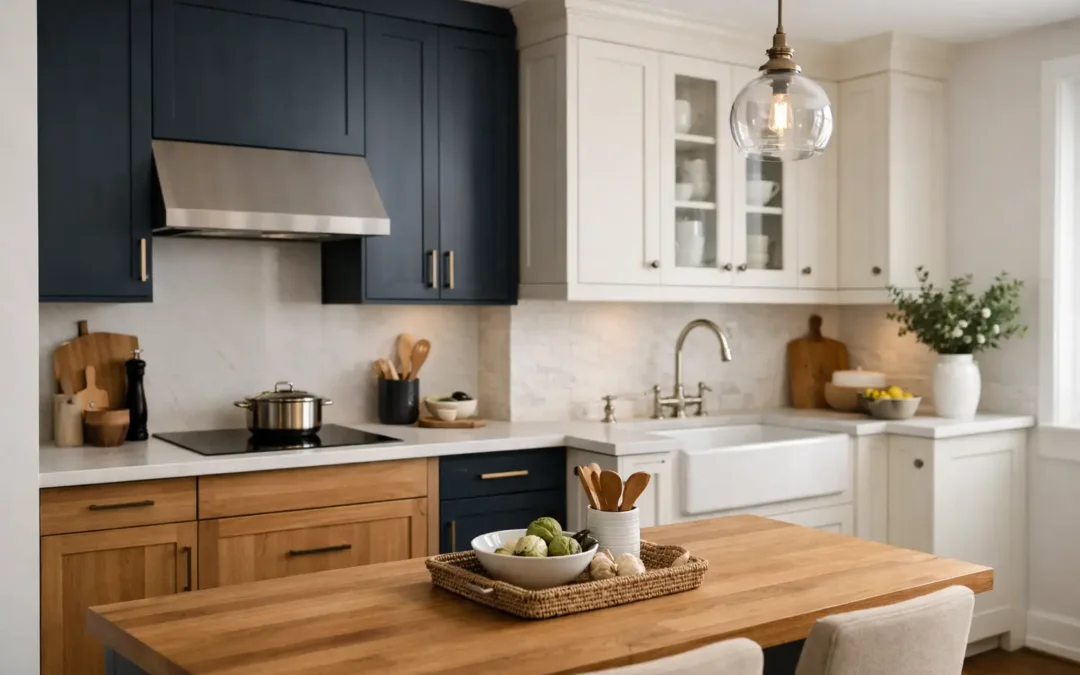
Painted finishes are particularly useful here. Soft greys, warm whites, muted greens and earthy blues can bridge traditional and modern elements very naturally. A plain slab door in a chalky painted tone will feel far less stark than the same door in bright gloss. Equally, a shaker door in a dark matt finish can feel more current than expected.
Timber can also be a useful link, though it needs careful handling. Natural oak, walnut or stained veneer can add warmth and texture, but too many wood tones in one room can make the design feel unsettled. If you are using timber cabinetry alongside painted units, repeat the timber elsewhere in the room through shelving, flooring or furniture so it looks deliberate.
Hardware is where style shifts quickly
Handles, knobs and catches have a surprisingly strong influence on where a kitchen sits stylistically. They are often the easiest way to introduce a modern or traditional note without changing the core cabinetry.
A classic shaker door with a slim bar handle can feel much more contemporary than the same door with a cup pull or ornate knob. Likewise, a simple slab door paired with a warm metallic handle or a more tactile aged finish can soften a very modern scheme.
There is a trade-off here. Statement hardware can add character, but if it is too decorative it may force the kitchen too far in one direction. In mixed-style schemes, restraint usually pays off. Choose hardware that complements rather than dominates.
Worktops, splashbacks and storage should support the blend
Cabinets do not sit in isolation. The supporting materials often decide whether the final kitchen feels balanced.
Natural stone or stone-effect worktops are a strong choice because they can move comfortably between styles. A heavily patterned marble may suit a more classic look, while a quieter quartz can keep things crisp. Timber worktops tend to read as more traditional or country in style, although they can work in smaller feature areas such as a breakfast dresser or coffee station.
Splashbacks can also nudge the mood. Full-height stone behind the hob feels more modern and architectural. Tiled splashbacks, especially with handmade texture or a softer glaze, introduce a more traditional layer. Neither is automatically better. It depends on the room and the overall level of detail already in play.
Storage design matters too. Modern kitchen planning tends to favour deep drawers, hidden internal organisation and clean appliance integration. Traditional kitchens may include larders, plate racks, glazed cabinets or furniture-style pieces. Combining these can be very successful, provided the practical side is not sacrificed for the look. A kitchen should still earn its keep every day.
Common mistakes to avoid
The biggest mistake is mixing styles without a plan. Choosing a traditional island because you liked one in a showroom, then adding modern perimeter units because they seem easier, can leave the room feeling unresolved. The design needs a thread running through it.
Another common issue is using too many focal points. If the cabinetry styles differ, the colours differ, the worktop changes and the lighting makes another statement, the room can become busy very quickly. A mixed kitchen often works best when two elements do the talking and the rest stay quieter.
Scale is another point that is easy to miss. Traditional cabinetry details that are too chunky can overwhelm a smaller room, while ultra-minimal modern units can look underwhelming in a large family kitchen with lots of architectural character. Proportion matters just as much as style.
A tailored design nearly always works better than copying a look
Photographs can be useful for inspiration, but they do not show how a kitchen needs to perform for a real household. A family that needs generous storage, durable finishes and room for everyday mess may need a very different interpretation of mixed styling than a couple renovating a quieter entertaining space.
That is where experienced kitchen design makes a genuine difference. The best results come from understanding the property, the people using the room and the level of contrast that will still feel right in five or ten years. At MBK Design, that is often what helps turn a good idea into a kitchen that feels settled from the moment it is installed.
If you are drawn to both classic character and cleaner modern living, that is not a problem to solve. It is often the starting point for a far more interesting kitchen – one that looks at home, works hard and still feels like your own.