
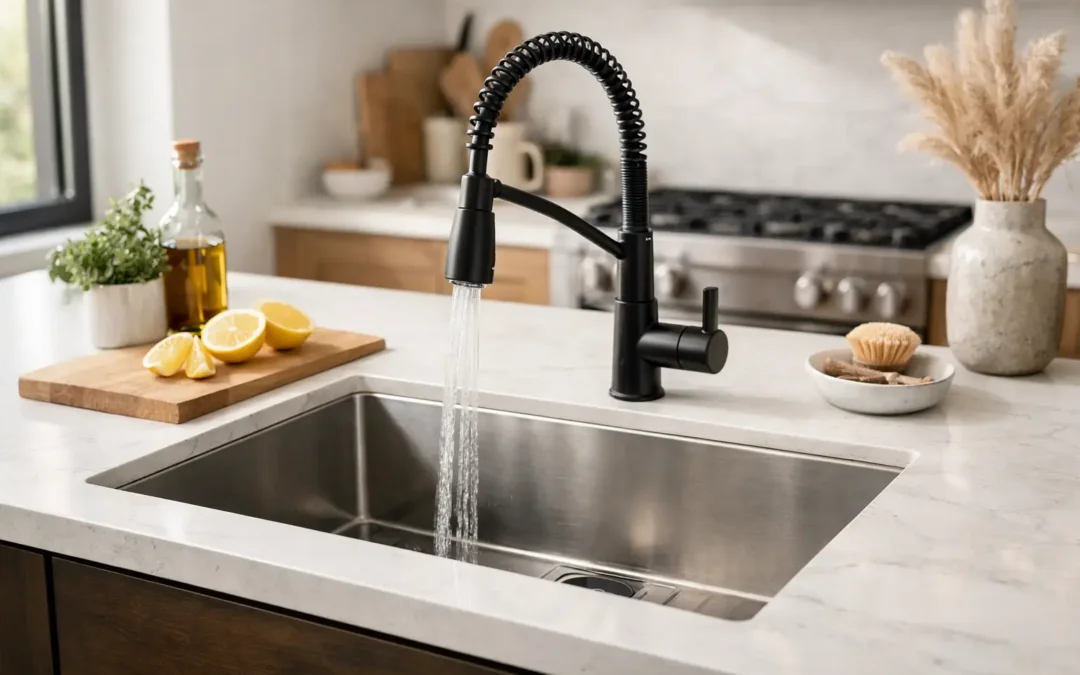
The sink is where a kitchen earns its keep. It handles muddy vegetables, large roasting tins, everyday washing up and the occasional hurried clean-up before guests arrive. A good kitchen sink buying guide starts with that reality: the right choice should suit how your household uses the room, while looking at home with your worktops, cabinetry and tap.
A sink may seem like a small detail beside a new layout or statement worktop, but changing it later can be awkward and expensive. Its size, material and fitting method affect both daily practicality and the finished appearance of the kitchen. Taking time to compare the options before finalising your design will pay off for years to come.
Kitchen sink buying guide: start with your routine
Before choosing a finish or shape, think about what happens at the sink on a normal weekday. A household that cooks from scratch most evenings, washes larger pans by hand or has children’s lunchboxes to rinse will usually appreciate a generous main bowl. A compact kitchen used mostly for quick meals may benefit more from preserving valuable worktop space.
One large bowl is simple, flexible and particularly useful for wide cookware. A bowl-and-a-half arrangement gives you a separate area for rinsing vegetables, draining pasta or stacking items while the main bowl is in use. Two full-size bowls suit keen cooks and busy family kitchens, although they require a longer cabinet and can leave less uninterrupted worktop.
Do not judge the size from photographs alone. Check the internal bowl dimensions, depth and the cabinet width required. A deep bowl can be excellent for hiding washing up and containing splashes, but it should not force the worktop too high for comfortable use. The best choice is often the one that supports your routine without dominating the room.
Consider the cabinet and worktop first
Your sink must work with the unit beneath it. Manufacturers specify a minimum cabinet width, and this should be treated as a firm requirement rather than a suggestion. The base unit must also accommodate plumbing, waste fittings and, where required, a waste disposal unit, boiling-water tap system or water filter.
Worktop material matters just as much. Laminate, timber, quartz, granite and solid surface tops each have different installation requirements. An undermounted sink, for example, is generally suited to solid, non-porous worktops such as quartz or granite rather than laminate, where the exposed inner edge could be vulnerable to moisture.
Planning these details together prevents an all-too-common disappointment: falling in love with a sink that cannot be fitted properly into the chosen kitchen design.
Choose a material that fits your priorities
There is no single best sink material. Each has strengths, maintenance needs and a character of its own, so the right answer depends on whether you prioritise ease of care, a particular style, impact resistance or a quieter washing-up experience.
Stainless steel
Stainless steel remains a popular and dependable option for modern and traditional kitchens alike. It is hygienic, heat-resistant and relatively light, with a broad choice of sizes and price points. A brushed finish can help disguise everyday water marks and light scratches better than a highly polished surface.
Quality varies, however. Thinner steel can sound noisier when pans are placed in the bowl and may feel less substantial. Better-quality models often include sound-deadening pads or coatings underneath. Stainless steel also rewards regular drying if you want to minimise water spotting, particularly in hard-water areas of Kent.
Composite granite
Composite granite sinks combine mineral particles with resin to create a dense, matt surface. Available in colours such as black, grey, cream and stone, they can make the sink feel more integrated with a carefully chosen worktop and kitchen palette. They are durable, quiet in use and well suited to a contemporary scheme.
The trade-off is that pale composite finishes can show tea, coffee or food stains if spills are left sitting, while very dark finishes may reveal limescale. Regular cleaning with products approved by the manufacturer keeps the surface looking its best. Avoid assuming that every composite sink has identical properties: colour consistency, heat tolerance and stain resistance can differ between ranges.
Ceramic and fireclay
Ceramic sinks bring a classic, substantial quality that works beautifully in Shaker, country and more traditional kitchens. Belfast and butler styles are especially popular where the sink is intended to be a visible design feature. Their glazed surface is easy to wipe clean and highly resistant to staining.
They are heavy, so the cabinet and installation need proper consideration. Ceramic can also chip if a heavy pan strikes the edge. That does not make it impractical, but it is a material best chosen with an understanding of its character rather than solely for its appearance.
Select the fitting style early
Inset sinks sit into a cut-out in the worktop, leaving a visible rim. They are versatile, straightforward to fit and compatible with many worktop materials. This makes them a sensible choice for a wide range of kitchen projects.
Undermounted sinks are fixed beneath the worktop, creating a clean edge that allows crumbs and spills to be wiped directly into the bowl. The look is refined and works particularly well with stone surfaces, but installation must be precise and the worktop needs to be suitable.
Flush-mounted designs sit level with the worktop for a sleek, architectural result. They demand careful fabrication, so they are best specified as part of the overall worktop process. Belfast and apron-front sinks project beyond the cabinet frontage or sit prominently at the front, creating a focal point rather than disappearing into the background.
If you are replacing a sink without replacing the worktop, an inset model in a compatible size is often the most practical route. For a complete renovation, it is worth choosing the fitting style alongside the worktop, cabinetry and tap rather than treating it as a final accessory.
Match the tap to the sink, not just the style
The tap and sink should be chosen as a pair. A high-arched spout is useful for filling pans and washing baking trays, but it needs enough clearance beneath wall cabinets or shelves. Pull-out spray taps offer excellent reach for rinsing corners and cleaning the bowl, while a conventional mixer can be a more understated and cost-effective choice.
Pay attention to the position of the tap hole. Some sinks have a pre-drilled hole, others offer a choice of positions, and undermounted models usually require the hole to be cut into the worktop. If you are considering a boiling-water tap, filtered-water tap or soap dispenser, make sure there is adequate room and that the cabinet can house the necessary equipment.
A draining board can be very useful, particularly where there is no dishwasher or where handwashing is part of daily life. In a compact kitchen, a drainer may reduce useful preparation space. In that case, a wire rack, bowl grid or removable drainer can provide flexibility without committing to a larger sink footprint.
Look beyond the bowl itself
The smaller components are easy to overlook, yet they affect how pleasant the sink is to use. A basket strainer makes food waste easier to remove. A quality waste fitting helps water drain efficiently. A protective grid can reduce marks in the bottom of the bowl, especially with ceramic and composite materials.
Think about cleaning too. Tight corners, elaborate grooves and poorly placed overflow openings can collect residue. Simple shapes with gently rounded internal corners are often easier to maintain than they first appear. Ask to see samples in person where possible, as a showroom visit will reveal texture, colour and scale far better than a screen can.
Set a realistic budget for the complete installation
The sink price is only one part of the cost. Allow for the tap, wastes, plumbing alterations, worktop cut-outs and fitting. Specialist worktop fabrication for undermounted or flush-mounted sinks may add to the budget, while a heavy ceramic model may require extra care during installation.
Spending more can be worthwhile when it delivers thicker material, a better finish, useful accessories or a warranty from a trusted manufacturer. Equally, the most expensive sink is not automatically the most appropriate one. A well-made inset stainless steel sink may be a better investment than a feature model that restricts your layout or creates unnecessary maintenance.
For homeowners planning a kitchen renovation in Maidstone or the surrounding area, discussing the sink during the early design stage helps ensure every element works together. At MBK Design, this is the point at which practical questions about cabinet space, worktop choice and installation can be resolved before orders are placed.
Choose a sink that feels right for the way you live, not simply for the photograph that first caught your eye. When the bowl is generous enough, the material suits your habits and the installation has been planned properly, it becomes one of the quietest signs of a kitchen designed to last.