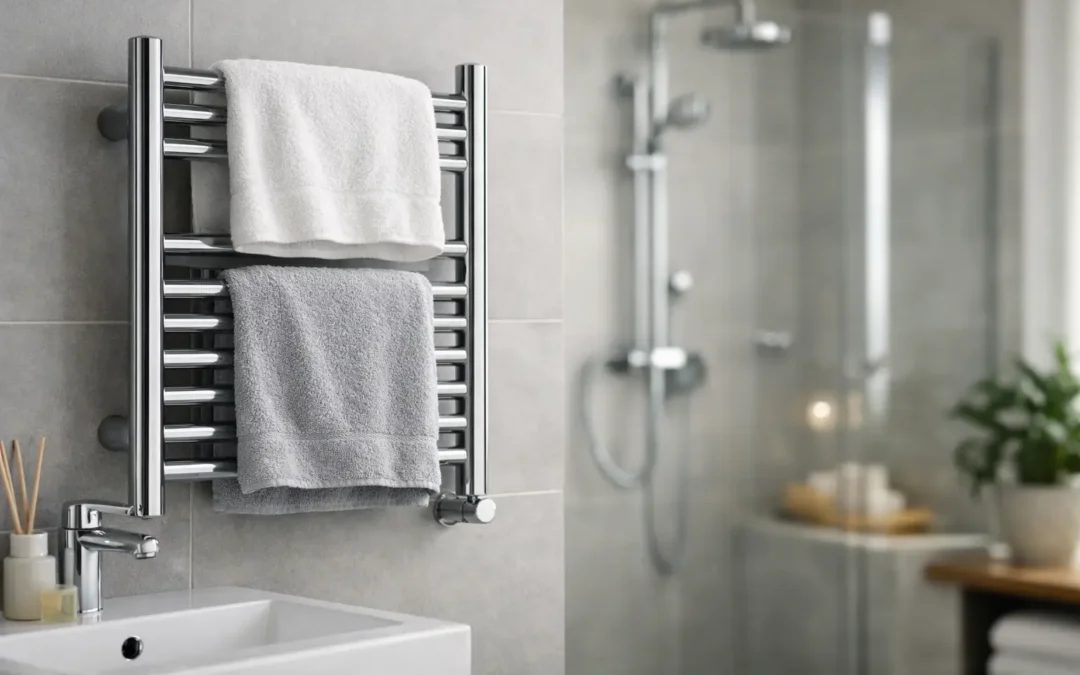
Step out of the shower on a cold morning and the appeal is obvious. A good heated towel rails review is not really about warm towels alone – it is about whether this fitting earns its place in a bathroom where space, heat and day-to-day comfort all matter.
For many homeowners, a heated towel rail sits somewhere between practical necessity and finishing touch. It can make a room feel more polished, keep towels drier between uses and free up wall space compared with a bulky radiator. Yet not every model performs equally well, and the right choice depends on the size of the room, the heating system in the home and how the bathroom is actually used.
Heated towel rails review – what are you really buying?
At first glance, most heated towel rails look fairly similar. Chrome bars, ladder layout, wall-mounted design. But performance varies more than many people expect.
You are usually choosing between three types. Plumbed models connect to the central heating system. Electric models run independently and are useful where extending pipework would be awkward. Dual fuel rails give more flexibility, allowing central heating use in winter and electric operation when the main heating is off.
That choice matters more than the finish or shape. In a family bathroom used heavily year-round, flexibility often counts for more than appearance alone. In a cloakroom or en suite, visual impact may take priority because the heating demand is lower.
Do heated towel rails actually heat a bathroom well?
This is where expectations need to be realistic. A heated towel rail can warm a bathroom, but not every one will do the job on its own.
In a compact en suite with decent insulation, a correctly sized rail may provide enough heat. In a larger family bathroom, especially one with high ceilings or solid external walls, it may struggle if used as the only heat source. This is one of the most common disappointments we see during bathroom planning. People choose a rail for the look, then assume it will perform like a full radiator.
Heat output is the key figure to check. If you want the rail to do more than dry towels, it needs to be sized for the room. Tiles, glazing, extraction and ceiling height all affect how warm the bathroom feels in use. Towels hanging over the bars can also reduce effective heat output, which is worth remembering if several bath sheets are in constant rotation.
For that reason, the best result is often a balance. A towel rail provides comfort and visual neatness, while underfloor heating or an additional heat source supports the room temperature. It depends on the layout and how much wall space is available.
Chrome, painted and designer finishes
Finish affects more than style. Chrome remains popular because it suits both modern and traditional bathrooms and tends to look clean and bright. The trade-off is that chrome rails often produce slightly less heat than comparable painted models.
Anthracite, matt black and coloured finishes have become more common in recent years, particularly in contemporary schemes. They can look excellent when paired with brassware or cabinetry, but the finish should work with the whole bathroom rather than standing out for the wrong reason. A towel rail is visible every day, so trend-led choices are best made carefully.
White remains a sensible option where you want the rail to blend quietly into the room. In more classic bathrooms, softer shapes and traditional valve details can help the rail feel in keeping rather than added as an afterthought.
Running costs and efficiency
A sensible heated towel rails review should address running costs, because this is often what homeowners ask after they have chosen a style they like.
Plumbed towel rails can be economical if they are part of an efficient central heating system, but their use is tied to when the heating is on. That can be frustrating in spring and summer when you still want dry towels without heating the whole house.
Electric models offer more control. Many can be fitted with timers or thermostatic elements so they operate only when needed. That can make them convenient and cost-effective in the right setting, though electricity is typically more expensive than gas per unit. Dual fuel models sit in the middle and often make the most practical sense for households that want flexibility throughout the year.
Efficiency is not just about the rail itself. Good insulation, sensible programming and choosing the right size all affect value for money. An oversized rail in a tiny room may waste energy. An undersized one may run often without delivering the comfort expected.
How to judge quality before you buy
Not all towel rails are built for the same level of use. This is particularly important in a busy household where fittings need to stand up to years of daily wear.
Build quality shows in the weight of the unit, the finish consistency, the welds, the brackets and the valves. Cheap models can look respectable online but disappoint once installed. Thin materials, poor plating and weak fixings are more noticeable over time, especially in bathrooms where moisture levels stay high.
Warranty length can be a useful guide, but it should not be the only one. A longer guarantee is reassuring, yet proper installation matters just as much. Even a strong product can underperform or leak if fitted badly. This is why selecting bathroom heating as part of a wider design and installation plan usually gives a better result than choosing pieces in isolation.
Sizing and placement matter more than most people think
A towel rail needs enough wall space around it to work properly and to look right in the room. Too narrow, and it will not hold practical-sized towels comfortably. Too large, and it can dominate a compact bathroom or interfere with doors, vanity units or shower screens.
Placement also affects everyday use. It should be easy to reach from the bath or shower, but not so close that towels become constantly damp from overspray. In family bathrooms, think about who is using it and how many towels need to hang there at once. In smaller spaces, projecting too far from the wall can make movement awkward.
This is one reason showroom advice still has real value. On paper, dimensions can seem fine. In a finished room, a few centimetres can make the difference between comfortable and cramped.
Are heated towel rails worth it?
For many bathrooms, yes – provided they are chosen for the right reasons.
If your priority is luxury, they deliver a daily comfort that people quickly get used to. If your priority is practicality, they help towels dry faster and can reduce that damp, stale feel in a bathroom with limited airflow. If your priority is room heating alone, the answer is more mixed. Some rails cope well; others are better treated as a secondary heat source.
They are most worthwhile when they fit into the wider bathroom design rather than being selected as a last-minute extra. A well-chosen rail can support the style of the room, improve comfort and make the space work better every day. A poorly chosen one can look smart but leave the room chilly.
Our verdict in this heated towel rails review
The strongest options are usually dual fuel or well-sized plumbed rails from reputable manufacturers, chosen with realistic expectations about heat output. Electric-only rails can be excellent in the right setting, especially for en suites, loft conversions or bathrooms where pipe runs are difficult.
Style should never be the sole deciding factor, but it does matter. Bathrooms are long-term investments, and a towel rail is part of the visual language of the room. It needs to complement the brassware, cabinetry, tiles and overall mood, whether you lean traditional or contemporary.
At MBK Design, we often find that homeowners feel more confident once they see bathroom heating choices in the context of a full design rather than as a standalone product. That is usually when the best decisions are made – not simply on price or looks, but on how the room will feel to live with.
If you are comparing options for a bathroom renovation, treat the heated towel rail as one part of a bigger comfort picture. The best choice is the one that suits your space, your heating setup and the way your household actually lives. Warm towels are lovely, of course, but getting the whole bathroom right is what you will appreciate for years.