
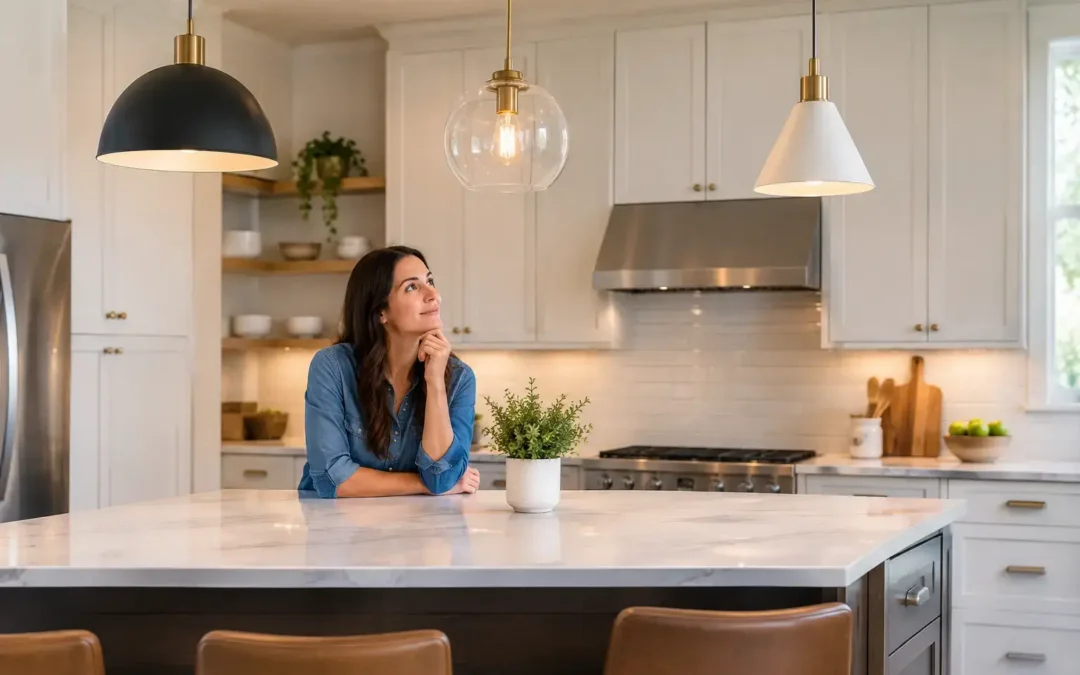
A beautiful worktop can disappear into shadow, while a single harsh ceiling light can make an otherwise well-planned kitchen feel flat and unwelcoming. Knowing how to select kitchen lighting is therefore not simply about choosing attractive fittings. It is about making the room safer to work in, more comfortable to spend time in and better suited to the way your household really lives.
Kitchen lighting should be considered early, alongside the layout, cabinetry and appliances. Leaving it until the end often means compromising on fitting positions, switches and the quality of light where it is most needed. A good plan uses several layers of light, each with a clear purpose.
How to select kitchen lighting in layers
The most successful kitchens rarely rely on one central pendant or a grid of ceiling spotlights alone. They combine ambient, task and feature lighting so the room can adapt from the weekday breakfast rush to a relaxed evening with friends.
Ambient lighting provides the general level of illumination for moving around the room. Ceiling downlights, discreet track lighting or well-positioned surface fittings can all do this job. The aim is even, comfortable light without gloomy corners or an overly clinical effect.
Task lighting is focused on places where precision matters: worktops, sinks, hobs and food preparation areas. Under-cabinet lighting is especially valuable because it puts light directly onto the work surface rather than behind the person preparing food. For a kitchen used regularly for cooking, task lighting is not a decorative extra. It makes chopping, reading recipe instructions and cleaning considerably easier.
Feature lighting gives the design character. This could be pendants above an island, a statement fitting over a dining table, illumination inside glazed cabinets or a soft glow along a plinth. It should support the overall scheme rather than compete with every finish in the room.
The balance matters. Too much feature lighting without useful task light can look impressive in photographs but become frustrating every day. Equally, a kitchen with only bright functional lighting may feel more like a workspace than the heart of the home.
Start with how you use the room
Before choosing a fitting, think honestly about what happens in your kitchen from morning to night. A compact kitchen used mainly for family meals needs a different approach from a large open-plan room that combines cooking, dining, homework and entertaining.
An island is often both a preparation area and a social focal point. It may need clear worktop lighting for practical tasks, but also pendants that create a sense of occasion when people gather around it. In this situation, dimmable fittings are usually a worthwhile investment. They allow bright light when cooking and softer light when the kitchen becomes a place to talk and unwind.
Dining areas deserve the same consideration. A pendant above a table can make the space feel purposeful and welcoming, but its size and height need care. Hang it too high and it loses presence; too low and it obstructs sightlines across the room. As a general guide, the bottom of a dining pendant often sits around 75 to 90 cm above the table, although the proportions of the fitting, ceiling height and table size should lead the final decision.
For households that use the kitchen early in the morning or late at night, low-level lighting is another useful option. Plinth lights, lights beneath an island overhang or subtle lighting within a pantry can provide safe navigation without switching on every ceiling light.
Choose the right colour temperature
The colour temperature of an LED is measured in Kelvin (K), and it has a significant effect on the atmosphere of a kitchen. This is an area where samples and showroom displays can be more revealing than product images.
Warm white light, typically around 2700K to 3000K, feels softer and more relaxed. It works particularly well in traditional kitchens, dining zones and rooms with timber, painted cabinetry or warmer stone tones. Cool white light, often 4000K or above, can feel brighter and more clinical. It is sometimes useful in utility areas, but it can make a main kitchen feel less inviting if used throughout.
For many homes, 3000K offers a sensible middle ground. It is clear enough for food preparation while still flattering cabinetry, flooring and natural materials. Where a kitchen opens into a living space, keeping the colour temperature consistent or very close across the areas helps the room feel considered rather than visually divided.
Also look at the colour rendering index, known as CRI. A higher CRI helps colours appear more natural, which matters when judging food, paint finishes and worktop materials. A CRI of 90 or above is a good target for a quality kitchen scheme.
Plan lighting around cabinets and worktops
Cabinetry affects where light falls. Downlights placed carelessly can create a shadow across the worktop because the person standing at it blocks the light. Positioning ceiling lights slightly in front of the cabinets, rather than directly overhead, can reduce this problem. The exact placement should be agreed with the kitchen plan, not guessed once the room is complete.
Under-cabinet lighting is one of the most effective additions to a kitchen, particularly beneath wall units. A continuous LED strip usually creates a more even result than individual puck lights, which can leave pools of brightness and dark gaps between them. Consider an aluminium profile with a diffuser for a clean finish and less glare on polished worktops.
Open shelving and glazed cabinets can benefit from internal lighting, but restraint is key. It is best used to highlight a few favourite pieces of glassware or ceramics, not every cupboard. In a contemporary kitchen, a slim integrated light source often suits the clean lines. In a more traditional scheme, decorative fittings and warmer illumination can add depth without feeling overly modern.
Select fittings that suit the scale of the room
A fitting may look modest in a showroom but dominate a smaller kitchen, especially over an island. Conversely, small pendants can get lost above a generous table or in a room with a high ceiling. Scale is not only about the width of a light fitting. It also includes its visual weight, the number of fittings, cable length and the materials around it.
Two or three pendants above an island can work well where the island is long enough to support them. In a compact room, one carefully chosen pendant or a pair of smaller fittings may be more balanced. Clear glass can appear visually lighter, while metal shades and darker finishes make a stronger statement and direct light more tightly downwards.
Think about cleaning, too. Highly detailed fittings, exposed bulbs and open glass shades can collect cooking residue and dust. They may be the right choice for a low-use dining area, but a practical, easy-to-wipe fitting is often better close to a hob or preparation zone.
Do not overlook glare, shadows and controls
Brightness alone does not equal good lighting. Glare from exposed LEDs, reflections in glossy cabinet doors and bright spots on a polished quartz worktop can make a kitchen uncomfortable. Diffused lighting, carefully angled downlights and dimmers all help create a calmer result.
Controls are equally important. It is helpful to separate lighting into zones, such as ceiling lights, under-cabinet task lighting, island pendants and feature lighting. That way, you can use only what is needed. A single switch that turns on every fitting may be convenient initially, but it gives little flexibility once the room is in daily use.
Smart controls can be useful, particularly for setting scenes or operating lights at different times of day. However, they are not essential for every project. Straightforward, well-labelled switches and reliable dimmers are often the best choice for a household that values simplicity.
Build lighting into the kitchen design from the outset
Lighting decisions affect electrical points, cabinet specifications, ceiling details and the overall budget. They are much easier to resolve while the kitchen is being designed than after work has started. This is also the point to decide where you are willing to invest. For many homeowners, quality task lighting and dimmable main lighting deliver more day-to-day value than spending the entire allowance on a dramatic statement fitting.
At MBK Design Studio, lighting is considered as part of the wider kitchen design, so it supports the chosen layout, materials and the way you want to live in the room. Seeing cabinetry, worktops and light finishes together can make decisions far clearer than choosing each element in isolation.
The best kitchen lighting is rarely the most elaborate scheme. It is the one that lets you prepare supper safely, find what you need at the back of a cupboard and make the room feel welcoming when the work of the day is done.