A toilet is rarely the first item people get excited about when planning a new bathroom. Yet the wrong height can be noticed every single day. This comfort height toilet comparison looks beyond the label, helping you decide whether a higher pan will genuinely make your bathroom more comfortable, practical and suited to your household.
The best choice is not automatically the tallest toilet available. It is the one that works for the people using it now, fits the room properly and still complements the style of the wider scheme.
What is a comfort height toilet?
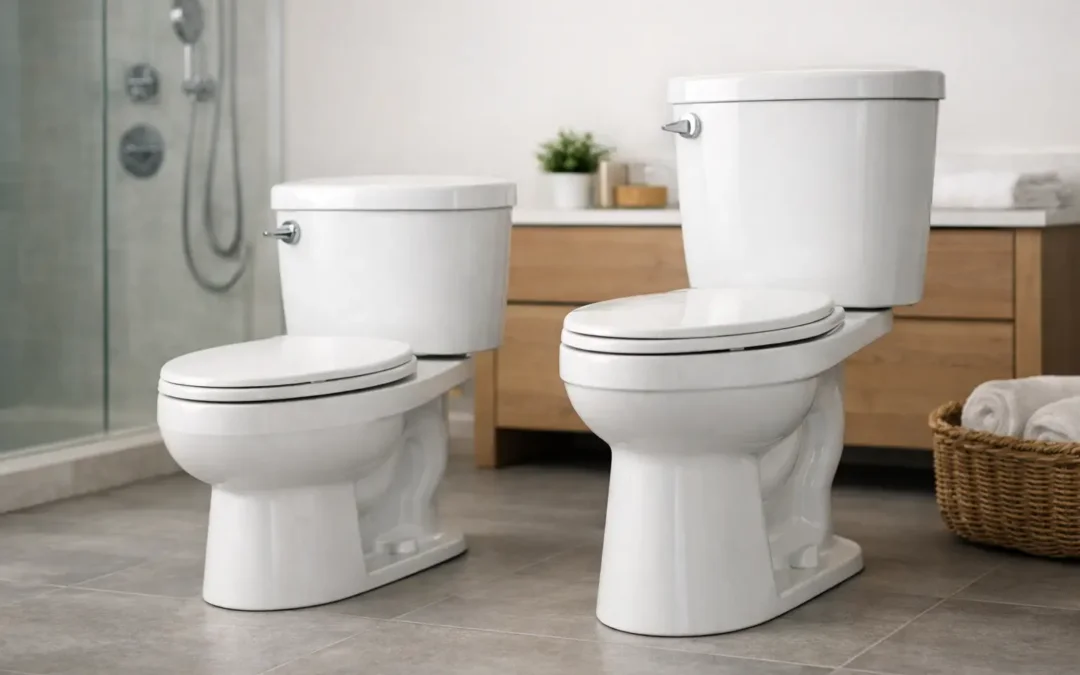
A comfort height toilet has a pan that sits higher from the floor than a conventional model. While dimensions vary between manufacturers, a standard toilet pan is often around 400mm high before the seat is fitted. Comfort height pans commonly sit around 430mm to 480mm high, with the seat adding a little more.
That difference may sound modest on paper, but it changes the sitting and standing position noticeably. A higher seat can reduce the distance someone needs to lower themselves and make rising again feel less demanding, particularly where knees, hips or balance are a concern.
You may also see these products described as raised-height, chair-height or accessible toilets. These terms are helpful starting points, but they are not interchangeable guarantees. Always check the actual specification, including whether the stated height is to the top of the ceramic pan or to the top of the seat.
Comfort height toilet comparison: the everyday difference
For many adults, especially taller people, a comfort height toilet feels more natural. The hip and knee angle is less acute, so getting on and off the seat can require less effort. It can be a thoughtful choice for a household planning to remain in its home for many years, rather than facing another bathroom alteration later.
However, higher is not always more comfortable. A person of shorter stature may find their feet do not rest firmly on the floor. This can feel unstable and may be less comfortable, particularly for children. In a family bathroom used by people of very different heights, a standard-height toilet may be the more balanced option.
The question is therefore less about which type is objectively best and more about who will use it most. If the bathroom is primarily for a couple who would benefit from a higher position, comfort height can be an excellent long-term decision. If it is the main bathroom for young children and shorter adults, it deserves more careful thought.
Do not confuse comfort height with formal accessibility
A comfort height pan may support easier use, but it does not by itself make a bathroom accessible or compliant with any particular standard. Accessible bathroom design considers the whole space: clear transfer room, door opening, basin position, grab rail support, controls, floor finish and the precise height and projection of sanitaryware.
If mobility needs are central to your project, it is worth discussing them at the design stage. A well-planned room can look refined and residential while making daily routines safer and easier. Leaving these decisions until products have been ordered often creates unnecessary compromises.
Comparing the main toilet styles
Comfort height is one part of the decision. The toilet’s form, projection, cistern arrangement and cleaning requirements matter just as much in a finished bathroom.
Close-coupled toilets
A close-coupled toilet has the cistern directly attached to the pan. It is familiar, straightforward and available in a wide choice of traditional and contemporary designs. It can suit a comfort height specification particularly well because the overall proportions remain reassuringly classic.
The trade-off is that there are more external surfaces around the pan and cistern to clean. In a compact bathroom, the visible cistern can also make the room feel slightly busier than a wall-hung option.
Back-to-wall toilets
With a back-to-wall toilet, the cistern is concealed in furniture or behind a boxed section of wall. This creates a neat, tailored appearance and can coordinate beautifully with vanity units, especially where storage is needed.
It is a good option when you want the calm look of concealed plumbing without the engineering considerations of a wall-hung pan. Check the depth of the furniture or boxing carefully, though. A shallow-looking toilet can still project a considerable distance into the room once the concealed cistern is allowed for.
Wall-hung toilets
Wall-hung toilets are fixed to a strong concealed frame, with the pan suspended above the floor. Their key advantage is flexibility: the mounting height can often be set to suit the users rather than relying on a fixed ceramic pan height. The clear floor beneath also makes cleaning simpler and can give a smaller room a lighter appearance.
They need proper planning from the outset. The supporting frame, wall construction, flush plate position and service access all need to be considered as part of the bathroom design. A wall-hung toilet can deliver a beautifully minimal result, but it should be chosen because it suits the project, not simply because it looks contemporary in a showroom.
Traditional and contemporary designs
Comfort height does not mean clinical-looking. There are elegant traditional close-coupled models with softer lines, as well as slim contemporary pans that work with furniture-led schemes. The most successful bathrooms match the toilet to the taps, basin, brassware finish, tiles and cabinetry rather than treating it as an isolated purchase.
Measurements that matter beyond seat height
When comparing toilets, height gets the attention, but projection can have a greater effect on how the room feels. Projection is the distance from the finished wall to the front of the pan. In a narrow en suite or cloakroom, even a few centimetres can affect clear walking space, door swing and how easily a drawer or shower screen can open.
Also consider the width of the pan, the position of the soil pipe, the depth of any boxing and the location of nearby furniture. A toilet that fits within the room’s broad dimensions can still be awkward if it crowds the basin or leaves insufficient room to move comfortably.
Seat design is worth examining too. Soft-close seats prevent slamming, but their shape and material vary. Slim seats can look refined, while a more substantial seat may feel more supportive. A quick sit in a showroom can reveal far more than a product photograph, particularly when comparing standard and comfort heights.
Hygiene, cleaning and water use
Modern toilets offer useful practical differences that are easy to overlook. Rimless pans direct the flush around the bowl without a conventional rim, reducing hidden areas where grime can collect and making cleaning more straightforward. Fully skirted pans conceal the trapway, creating smoother external lines with fewer awkward corners.
Neither feature removes the need for regular cleaning, but both can make a real difference in a busy household. The quality and effectiveness of the flush should also be assessed, not just the water-saving figure. A poorly performing low-volume flush can lead to repeat flushing, which is frustrating and defeats the purpose.
For a bathroom designed to last, choose a well-made toilet from a reputable range with readily available replacement seats and flush components. A toilet is a long-term fitting, and the practical value of parts availability should not be underestimated.
How to choose with confidence
Start with the people, not the product brochure. Think about the height and mobility of the regular users, whether children will use the room, and whether this is a home you expect to enjoy well into the future. Then establish the available floor space and plumbing constraints before narrowing down styles and finishes.
It is also sensible to view the toilet alongside the basin and furniture rather than making separate decisions. In a well-designed bathroom, sightlines, proportions and circulation are resolved together. That is particularly valuable when a higher toilet is being introduced into a compact space, where the visual balance can change quickly.
At MBK Design Studio, the most useful conversations often begin with how a client wants the room to feel and function day to day. Seeing different pan heights and bathroom layouts in person gives homeowners a clearer basis for choosing than online dimensions alone.
A comfort height toilet can be a small adjustment with a significant daily benefit. Take the time to sit, compare and measure before committing, and your finished bathroom will feel considered not just on the first day, but for years afterwards.