A kitchen can look generous on paper and still feel short of space once real life moves in. The cereal boxes need a home, the pans stack awkwardly, small appliances claim the worktop, and suddenly the room feels harder to use than it should. The best kitchen storage solutions are the ones that make everyday routines easier, not just the ones that look clever in a brochure.
For most households, good storage is less about squeezing in more cupboards and more about planning the right kind of storage in the right place. That means thinking about how you cook, what you use daily, and where clutter tends to build up. A well-designed kitchen should help the room stay calm and practical, whether you are feeding a family, entertaining friends or simply trying to make weekday mornings run more smoothly.
What makes the best kitchen storage solutions work
The strongest storage plans start with behaviour, not products. There is little value in a beautiful internal organiser if it sits in the wrong cabinet, and no benefit in extra wall units if the items you need most are still awkward to reach. Good storage works because it follows the way the kitchen is actually used.
That usually means keeping preparation items near worktops, pans near the hob, crockery close to the dishwasher or sink, and food storage where it can be seen clearly. It also means being honest about what needs hiding away and what deserves easy access. A household that cooks from scratch several nights a week needs very different storage from one that relies more on quick meals and occasional entertaining.
There is always a balance to strike between capacity and comfort. Packing every corner with cabinetry can increase storage on paper, but it may leave the room feeling heavy or reduce the sense of space. In some kitchens, fewer but better-designed cupboards create a more enjoyable room overall.
Deep drawers often beat standard base units
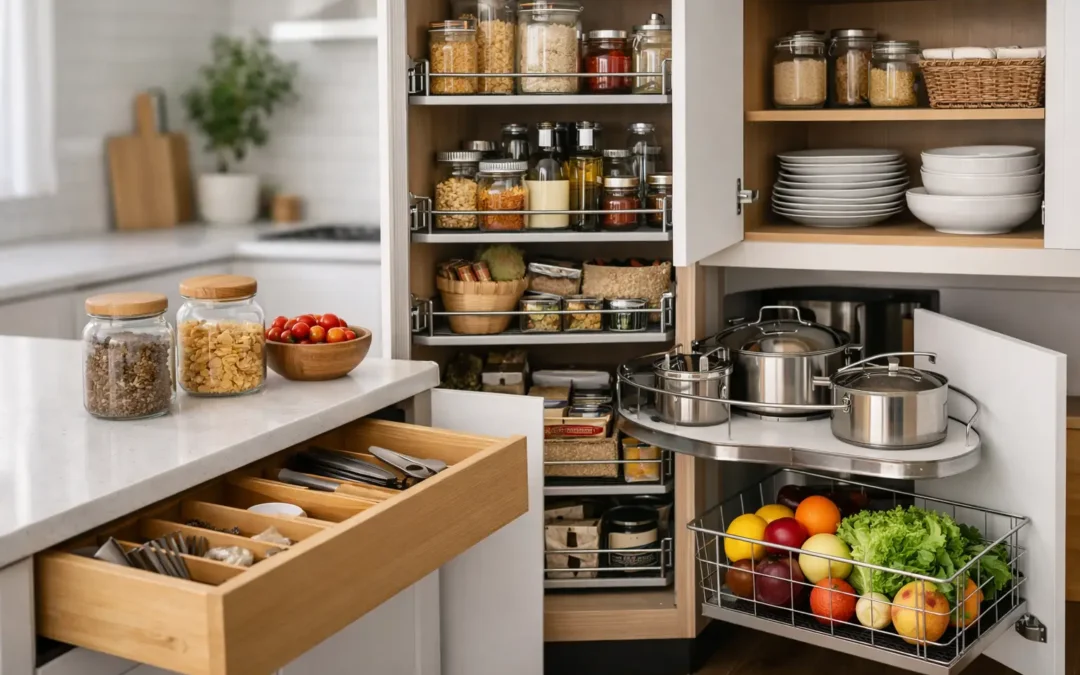
If there is one change that improves day-to-day usability in many kitchens, it is the move from traditional base cupboards to deep drawers. Standard cupboards can quickly become dark, inconvenient spaces where items disappear at the back. Deep drawers bring everything forward, making pans, lids, mixing bowls and food containers much easier to see and reach.
They are particularly useful beneath hobs and in main prep zones. Rather than kneeling down to search through a shelf, you can open a drawer and access the full depth immediately. Internal dividers make a noticeable difference here, especially for keeping utensils, lids and dishes in order.
The trade-off is cost. Drawer systems are usually more expensive than simple cupboards, so they may be worth prioritising in the hardest-working areas first rather than everywhere.
Corner storage needs careful thought
Corner cabinets are often where kitchen storage plans succeed or fail. Left untreated, they become awkward voids that are difficult to access. The right internal solution can turn them into useful storage for larger cookware, serving dishes or less frequently used appliances.
LeMans-style pull-out systems, half-moon shelves and fully accessible corner mechanisms all have their place. Which works best depends on cabinet size, door configuration and budget. In some cases, a simpler corner arrangement with easier adjacent storage is the better answer, especially if the mechanism adds cost without improving how the household uses the kitchen.
This is where experience matters. A corner unit should not be chosen because it sounds impressive. It should be selected because it solves a real access problem.
Tall larders and pantry units create order quickly
One of the best kitchen storage solutions for busy households is a well-planned tall larder. It keeps dry goods, tins, jars, spices and snacks in one organised area, which makes both cooking and shopping far simpler. Instead of spreading food storage across several wall and base cabinets, a larder gives it a clear home.
Internal racks, pull-out shelves and adjustable shelving all add flexibility. Families often appreciate being able to separate children’s snacks from baking ingredients or bulk groceries. For keen cooks, grouping ingredients in one place can make meal preparation much quicker.
Not every kitchen has room for a generous walk-in pantry, but a tall pull-out larder or double-door pantry cabinet can still deliver many of the same benefits. The key is visibility. If you cannot see what you have, you tend to overbuy and underuse.
Best kitchen storage solutions for small appliances
Kettles, toasters, coffee machines and air fryers often create the most visual clutter. They are useful, but too many on display can make even a new kitchen feel busy. The answer is not always to hide everything, because appliances used every day need to remain practical.
An appliance garage can work well for households that want cleaner lines without sacrificing convenience. Pocket doors or lift-up fronts allow small appliances to stay plugged in and ready to use while keeping the worktop looking tidier when not in use. In larger kitchens, a dedicated breakfast cupboard can perform a similar role.
That said, these features need the right dimensions and ventilation. A cramped cabinet that barely fits the appliance is frustrating from the start. It is better to plan for the actual items you own than to assume a standard cupboard will cope.
Drawer inserts and internal organisers matter more than people expect
A beautifully designed kitchen can still feel untidy if the inside of the drawers has not been considered. Cutlery trays are only the beginning. Spice inserts, pan dividers, plate holders, peg systems and bin storage can all improve the way a kitchen functions.
These details are especially valuable in contemporary kitchens where the goal is a clean external appearance. The less visual noise there is outside the cabinets, the more important internal organisation becomes. It helps maintain that calm look without making the kitchen harder to use.
There is no need to overcomplicate every drawer. The best results usually come from focusing on the zones that get used most heavily and adding structure where clutter builds fastest.
Make wall storage earn its place
Wall units remain useful, but they should not be treated as the default answer to every storage shortfall. In some kitchens, especially those with lower ceilings or limited natural light, too many wall cabinets can make the room feel enclosed.
Open shelving can soften the look and provide display space for attractive everyday items, but it does require discipline. It suits homeowners who like a styled, curated appearance and are willing to keep it that way. If you prefer everything hidden, enclosed cupboards are usually the more practical choice.
A balanced design often works best – enough wall storage for essentials, combined with better base and tall storage to avoid overloading the upper half of the room.
Don’t waste the space under the sink
The sink cabinet is often treated as a leftover zone, yet it can be extremely useful when planned properly. Cleaning products, caddies, recycling and liners all need a home, and this area is usually the natural place for them.
Purpose-built under-sink storage makes far better use of the awkward shape around plumbing. Pull-out bins are particularly effective, helping keep waste and recycling concealed but accessible. In family kitchens, this contributes as much to day-to-day order as any feature drawer or larder unit.
It is a small example of a larger point. Storage works best when even the difficult spaces are considered, rather than ignored.
Island storage can transform a kitchen layout
Where space allows, an island can provide some of the best kitchen storage solutions in the room. It creates opportunities for wide pan drawers, casual crockery storage, hidden bins or even book and serving storage on the outer side.
The advantage is not just capacity. An island can position storage exactly where it is needed for preparation and social use. If the island is used for chopping, baking or serving, keeping the right items directly beneath makes the whole kitchen feel more intuitive.
Of course, an island must earn its footprint. In tighter rooms, forcing one into the layout can reduce circulation and make the kitchen feel cramped. A peninsula or reworked perimeter layout may deliver better storage without compromising movement.
Bespoke planning usually beats buying more containers
Many homeowners try to solve kitchen clutter after installation by adding baskets, tubs and organisers. These can help, but they rarely fix a layout that was not planned around real storage needs in the first place. The most successful kitchens consider storage from the start, during the design stage.
That includes taking stock of cookware, food habits, entertaining needs and even the appliances you expect to buy in future. It also means understanding where compromise is sensible. Not every kitchen needs every mechanism, and not every premium add-on will represent good value.
For homeowners investing in a renovation, this is where showroom-led design and experienced guidance pay for themselves. A thoughtful plan can often create better results than a larger kitchen with less attention to detail.
Storage should support the way you want to live
A kitchen is not easier to use simply because it contains more units. It becomes easier when storage feels natural, reachable and proportionate to the way the household lives. That may mean deep drawers instead of cupboards, a proper larder instead of scattered food cabinets, or fewer wall units with smarter internal organisation.
In homes across Maidstone and the wider Kent area, that practical thinking often matters just as much as the finish or door style. A kitchen should look the part, certainly, but it should also reduce friction every single day. If your storage choices make cooking, cleaning and family life feel simpler, you are on the right track.
The best starting point is often the simplest one – look at what frustrates you in your current kitchen, because that is usually where the smartest storage decisions begin.