
A granite worktop can look as good after years of family breakfasts, dinner parties and busy weekday cooking as it did on the day it was fitted – but it needs the right care from the outset. Knowing how to protect granite worktops is less about fussy routines and more about understanding what the stone can tolerate, where it is vulnerable and which everyday habits make a genuine difference.
Granite is valued for its natural pattern, depth of colour and reassuringly solid feel. It is also a practical choice for a kitchen, but it is not completely maintenance-free. Each slab is naturally different, and its resistance to staining depends on its mineral make-up, finish and the quality of its protective seal. Treat it well and it will remain a hardworking, beautiful part of your kitchen for many years.
How to protect granite worktops from day one
The best time to think about protection is before the worktop becomes part of daily life. A professionally prepared granite surface will normally be sealed before use, helping to reduce the chance of liquids soaking into the stone. Sealing does not create a plastic-like coating on top of the granite. Instead, it works below the surface, slowing absorption so spills can be wiped away before they leave a mark.
The level of protection required varies. Dense, darker granites may be naturally less absorbent than paler or more open-grained stones, while honed finishes can show marks more readily than a highly polished surface. This is why treating every granite worktop in exactly the same way can lead to disappointment. Ask about the particular stone selected for your kitchen, rather than relying on broad claims that all granite needs little attention.
When planning a new kitchen, practical detailing also matters. Positioning a draining area sensibly, allowing suitable space around the hob and choosing an appropriate edge profile can all make the surface easier to live with. Good kitchen design protects materials as well as improving how the room works.
Check whether your granite needs resealing
A sealant gradually wears down through cleaning, cooking and general use. It does not necessarily need replacing every year, and applying more product than necessary is not always helpful. A simple water test is a sensible starting point.
Place a few drops of water on a clean, dry and inconspicuous part of the worktop. If the water remains beaded on the surface for around 10 to 15 minutes, the seal is likely still doing its job. If the stone darkens quickly as the water is absorbed, it may be time to reseal. Wipe the area dry afterwards rather than allowing water to sit for an extended period.
Resealing without creating new problems
Use a sealant designed specifically for natural stone and follow its instructions carefully. The worktop must be thoroughly clean and fully dry first. Applying sealant over grease, residue or moisture can trap marks beneath the protective treatment and leave an uneven result.
Work in manageable sections, apply a light and even coat, then remove any excess within the stated time. Leaving residue to dry on the surface can create hazy patches that are difficult to buff away. If you are unsure about the existing finish, the type of stone or the right product, it is better to seek specialist advice than experiment across a prominent worktop.
Clean granite gently, but consistently
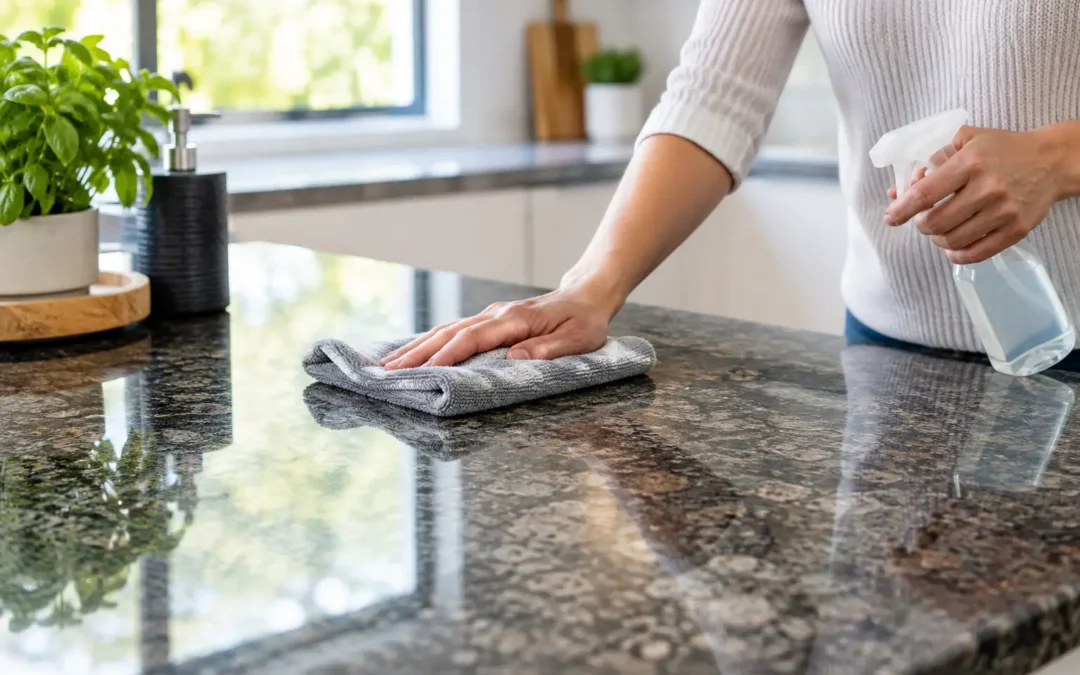
The everyday routine is simple: wipe spills promptly with a soft cloth or microfibre cloth, then clean the surface with warm water and a pH-neutral stone cleaner where required. Drying the worktop after cleaning prevents water marks and keeps polished granite looking clearer, particularly in hard-water areas of Kent.
Ordinary washing-up liquid can be used occasionally in a very diluted amount, but it should not become the main cleaning method. Repeated use may leave a film that dulls the shine and attracts smears. A stone-safe cleaner is a more reliable choice for regular care because it cleans without gradually undermining the sealant.
Avoid aggressive products, even when the label promises a brilliant shine. Bleach, oven cleaner, limescale remover, bathroom spray, abrasive cream cleaners and products containing strong acids or alkalis can damage the seal, affect the surface finish or leave the granite looking patchy. Natural remedies are not automatically safe either: vinegar, lemon juice and bicarbonate of soda are often suggested online, but they are poor choices for routine natural-stone care.
Protect against heat, scratches and impact
Granite is heat resistant, which is one of its major strengths in a busy kitchen. However, heat resistant does not mean invulnerable. Sudden, concentrated temperature changes can place stress on natural stone, particularly near cut-outs, joins and edges. Use trivets or heatproof mats beneath roasting tins, slow cookers and very hot pans rather than making the worktop the default landing place.
Always use a chopping board. Granite is hard enough to blunt knives, and while the stone is resistant to scratching, dragging rough cookware, ceramic bases or heavy appliances across it can mark the finish or damage an edge. Do not stand or sit on the worktop either. The middle of a slab is strong, but unsupported areas and cut-outs around sinks or hobs deserve particular care.
There is a trade-off here. A kitchen should feel comfortable to use, not like a showroom where nobody cooks. Protective habits should be easy ones: a board by the prep area, a trivet close to the hob and a soft mat under small appliances that are moved frequently.
Deal with spills before they become stains
Oil, red wine, tea, coffee, fruit juice and strongly coloured sauces are more likely to leave a mark if they are allowed to sit. Blot the spill rather than rubbing it across a larger area, then clean with a stone-safe product and dry the surface. Speed matters more than scrubbing.
If a stain does appear, do not assume the worktop is ruined. Some marks sit in the sealant or near the surface and can be improved with a suitable specialist treatment. The correct approach depends on the cause of the stain. An oily mark needs a different treatment from rust, dye, water discolouration or a chemical etch. Applying random household cleaners can make diagnosis harder and may create a more noticeable patch than the original stain.
Etching is another point worth understanding. Granite is generally more acid resistant than marble, but some stones contain minerals that can react, and a damaged seal can make the surface more susceptible to marks. If the affected area looks dull rather than darker, it may be a change to the finish rather than a traditional stain. Professional assessment is often the safest route for prominent or persistent marks.
Give high-use areas extra attention
The space around the sink, dishwasher, kettle and hob works harder than the rest of the kitchen. These areas encounter repeated water, steam, heat and food preparation, so they deserve regular wiping and occasional checks for changes in how water behaves on the surface.
Keep damp cloths away from the worktop when they are not in use, and do not leave wet washing-up bowls, bottles or metal containers in one place for days. Water itself is unlikely to harm properly sealed granite, but trapped moisture, mineral deposits and residues can spoil the appearance over time.
For homeowners investing in a kitchen designed around daily family life, aftercare should be part of the decision from the beginning. At MBK Design Studio, material choices are considered alongside layout, cooking habits and the level of maintenance a household is genuinely happy to take on. That honest conversation helps create a kitchen that remains practical as well as impressive.
When to call in a specialist
Seek expert help if you notice a spreading stain, a chip near a sink or hob cut-out, a persistent dull patch, loose sealant around an adjacent surface, or a crack. Small issues are usually easier to address before water and dirt reach deeper into the stone or surrounding cabinetry.
A specialist can identify whether the problem is in the stone, the sealant or the finish, then recommend an appropriate cleaning, repair or resealing method. This is particularly worthwhile for an expensive or distinctive slab, where an incorrect product could permanently alter its appearance.
The most effective protection is built from small, sensible habits rather than constant worry. Wipe spills promptly, use stone-safe cleaners, renew the seal when the stone shows it needs it and give hot pans and sharp knives their own place. Your granite worktop will then be free to do what it was chosen for: bringing lasting character and dependable performance to the heart of your home.