When a spare room has to work as both bedroom and office, poor planning shows up quickly. A desk that blocks the wardrobe, cables across the floor, nowhere to store paperwork, and a room that never feels properly restful. The best small bedroom study room ideas solve those pressures at the design stage, so the space feels calm, organised and genuinely useful every day.
For most homeowners, the challenge is not simply fitting in a desk. It is making the room perform well without looking cramped or temporary. That usually means thinking beyond freestanding furniture and considering how layout, storage, lighting and joinery can work together. In a smaller room, every centimetre matters, and the most successful schemes are the ones that give each area a clear purpose.
Start with the layout, not the furniture
It is tempting to begin by choosing a desk or a bed, but layout should come first. In a small room, circulation space matters just as much as the pieces you put into it. If you cannot open drawers comfortably, reach the window easily or move around the bed without twisting sideways, the room will feel awkward no matter how attractive the finishes are.
A good starting point is to decide which function needs the strongest visual presence. If the room is mainly used as a bedroom with occasional home working, the bed should remain the dominant feature and the study area should feel integrated and discreet. If it is used for work every day, the desk position deserves more priority, especially for natural light and comfort.
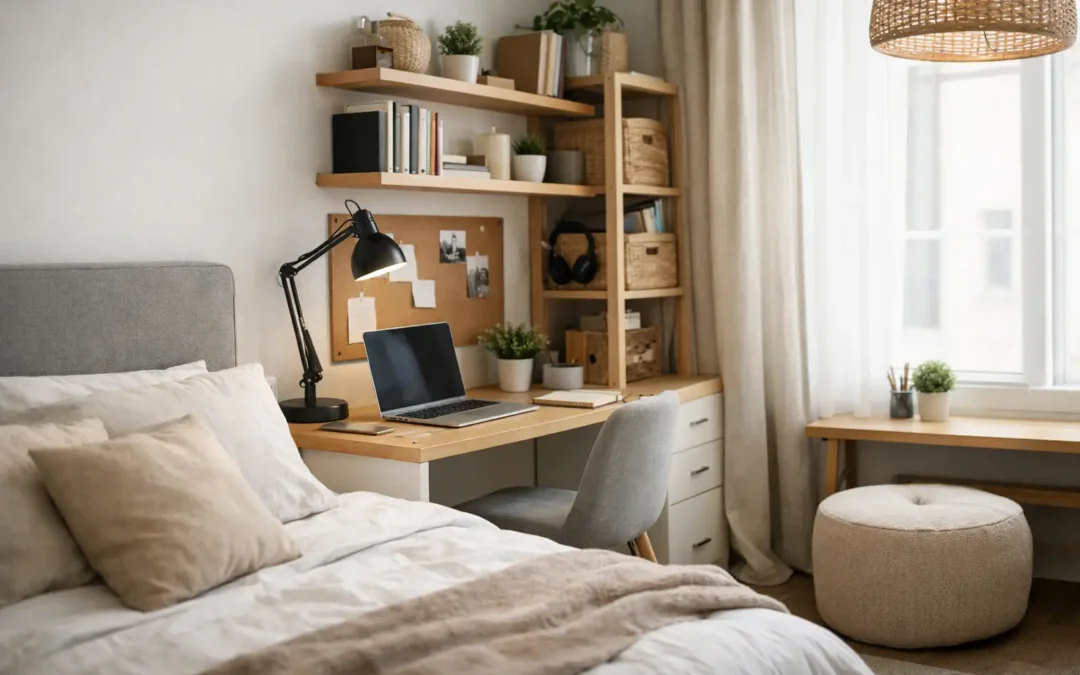
In many cases, placing the desk along one wall rather than pushing it into a corner gives a better result. Corners can work, but they often create dead space and make the room feel tighter. A fitted desk with shelving above can sit neatly on a narrow wall and look intentional rather than improvised.
Fitted furniture usually works harder in small spaces
One of the most reliable small bedroom study room ideas is to use fitted furniture instead of trying to assemble a room from separate pieces. Freestanding items can leave awkward gaps, waste height and make a compact space feel visually busy. Fitted solutions can be planned around alcoves, chimney breasts, sloped ceilings and uneven walls, which is particularly valuable in older Kent homes where rooms are rarely perfectly square.
A fitted run can combine a desk, wardrobes, drawers and open shelving in one continuous design. That creates a cleaner look and often gives far more usable storage than individual units. It also helps the room feel balanced, because the work zone becomes part of the overall bedroom design rather than an afterthought.
There is a trade-off, of course. Fitted furniture is a more considered investment and needs proper planning. But if the room has to work hard for years rather than months, it often delivers better value through durability, storage capacity and day-to-day ease.
Choose a desk depth that suits the room
Not every home office needs a deep executive desk. In a small bedroom, over-sizing the worktop is one of the quickest ways to lose valuable floor space. For laptop-based work, a slimmer desk may be entirely adequate, especially if additional storage is built above or beside it.
That said, the right depth depends on how the room is used. If you need two screens, regular paperwork or space for creative work, going too shallow will become frustrating. A desk should feel comfortable enough for proper use, not like a shelf you are trying to work from. This is where bespoke planning helps, because proportions can be tailored to your exact routine.
A floating desk can also make the room feel lighter. By keeping the floor visible below, the whole space appears more open. If enclosed drawer units are needed, placing them to one side rather than under the full width of the desk often keeps the design from feeling heavy.
Make storage do the real work
In smaller dual-purpose rooms, clutter is usually the real problem rather than lack of square footage. A room can be modest in size and still feel calm if everything has a place. It can also be generous in size and feel chaotic if storage has not been thought through properly.
That is why the strongest small bedroom study room ideas nearly always involve layered storage. Closed cupboards are useful for printers, paperwork and cables you do not want on show. Drawers help with smaller items, while open shelves can display a few books or decorative pieces without overwhelming the room.
The key is restraint. Too much open shelving can make a room feel visually noisy, which is not ideal in a bedroom. A better balance is often to use mostly closed storage with a limited amount of open display space. This keeps the room restful while still allowing character.
Full-height cabinetry is especially effective because it uses vertical space rather than spreading storage across the floor. In compact bedrooms, going upwards usually works better than going wider.
Keep the room restful as well as practical
A study area in a bedroom should not make the whole room feel like an office. This matters more than many people expect. If work materials dominate the space, it can be harder to switch off in the evening, and the room loses the comfort that a bedroom should provide.
Colour and finish choices help here. Softer tones, timber textures and painted cabinetry tend to sit more comfortably in a bedroom setting than stark corporate finishes. A desk area does not need to shout to be functional. In fact, the most effective schemes are often the most understated.
You can also soften the transition between zones with design details such as matching wardrobe and desk finishes, integrated handles, or shelving that ties the whole scheme together. When the study area looks like part of the bedroom rather than separate furniture added later, the room feels more coherent.
Lighting needs more thought than a single ceiling fitting
Lighting is often overlooked, yet it has a major effect on how well a bedroom office performs. A single central pendant rarely gives enough light for practical working, and it can cast shadows exactly where you do not want them.
Natural light should be used well where possible, but desk placement has to be balanced with the rest of the room. Facing a window can be pleasant, but depending on screen use and glare, it is not always ideal. Setting the desk adjacent to the window often works better, giving good daylight without harsh reflection.
Layered artificial lighting is equally important. A focused task light at the desk, softer bedside lighting and general ambient lighting all support different uses of the room. This flexibility becomes particularly valuable in winter when many people are working during darker hours.
Think carefully about the bed type
Not every small bedroom can comfortably take a standard double bed and a full study setup. In some rooms, the smartest solution is to rethink the bed rather than keep squeezing everything else.
A guest room that doubles as a study may benefit from a sofa bed or a well-designed wall bed if overnight use is occasional. That instantly frees up more space for everyday working. In a regularly used bedroom, storage beds with drawers underneath can reduce pressure elsewhere in the room.
This is always a question of priorities. If the room is occupied every night, comfort should not be compromised too far for the sake of a larger desk. But if the bedroom function is secondary, a more flexible bed arrangement can transform the usability of the space.
Use awkward areas properly
Small rooms often include alcoves, eaves or narrow wall sections that are difficult to furnish with off-the-shelf pieces. These awkward spots can become some of the most useful parts of the room when planned well.
An alcove can house a compact fitted desk. The space above can take shelving or cupboards, and the result often feels tidier than placing a desk on the main wall. Under-eaves storage can keep files, seasonal items or spare bedding out of sight. Even a shallow recess can become a useful charging station, bookshelf or drawer bank.
This is one area where experienced design input makes a real difference. What looks like unusable space on first viewing can often be turned into storage that makes the whole room function better.
Keep cables and technology under control
No matter how attractive the furniture is, visible trailing leads can make a fitted study look unfinished. Cable management should be planned from the start, especially if the room includes a monitor, printer, lamp and charging points.
Built-in cable ports, discreet sockets and hidden charging areas keep surfaces clearer and safer. It is a practical detail, but one that strongly affects how polished the final room feels. If video calls are part of your working week, background appearance matters too. Clean lines and tidy storage create a more professional setting without making the room feel formal.
Good design depends on how you actually live
The most successful rooms are not based on trends. They are based on routines. A couple may need one spare room to act as guest bedroom, office and dressing area. A family may want a homework station that later becomes a home office. Someone working from home full time may need storage for files and equipment, while another person only needs a quiet corner for occasional admin.
That is why there is no single formula for small bedroom study room ideas. It depends on who uses the room, how often they work there, and how much they need the bedroom side to remain calm and uncluttered. A well-planned fitted solution can bring those needs together in a way that loose furniture rarely does.
If you are weighing up how to make a compact room work harder, it is worth slowing down and planning it properly. The right design will not just help you fit everything in. It will make the room easier to live with, easier to keep tidy, and far more enjoyable to use every day.