
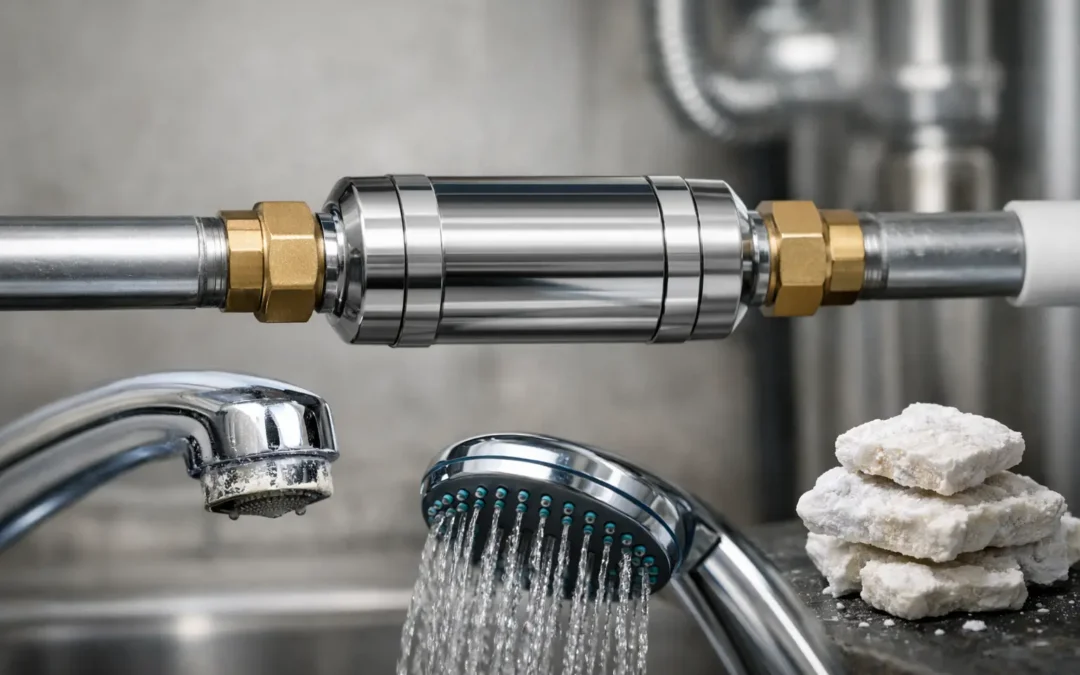
A new bathroom can look immaculate on handover day, but hard-water marks soon show up on shower glass, taps and tiles if limescale is not considered early enough. This Aquabion limescale system review looks at what the technology is designed to do, what it cannot do, and whether it is a sensible choice for a home in a hard-water area such as Kent.
The short answer is that Aquabion can be a worthwhile option for homeowners who want to reduce the damaging effects of scale without fitting a conventional salt-based water softener. However, it should be chosen for the right reasons. It treats the behaviour of minerals in the water rather than removing those minerals altogether, so expectations matter.
What is an Aquabion limescale system?
Aquabion is an electrolytic water-treatment system fitted to the incoming mains supply. Its purpose is to alter how dissolved calcium and magnesium behave as water is heated or evaporates. These minerals are responsible for limescale, particularly in areas with hard water.
A conventional water softener works by removing hardness minerals through an ion-exchange process, usually using salt. An Aquabion unit does not operate in that way. It uses a zinc anode and an electrolytic process to encourage minerals to form in a less adhesive structure. In simple terms, the aim is to make scale less likely to bond stubbornly to pipes, heating elements and visible bathroom surfaces.
That distinction is central to any honest review. Water treated by Aquabion is still hard water. You may still see mineral residue, particularly where droplets are left to dry on dark surfaces or shower screens. What may improve is how readily the residue wipes away and how much hard scale accumulates in the first place.
Aquabion limescale system review: where it performs well
The most persuasive case for Aquabion is usually long-term protection of a home’s plumbing and water-using appliances. Limescale can build inside hot-water cylinders, boilers, shower valves, taps, dishwashers and washing machines. It also reduces the efficiency of heating elements, which is particularly unwelcome when households are conscious of energy use.
For a bathroom refurbishment, the benefit is often practical rather than dramatic. A system may help reduce the crusty deposits that gather around shower heads, tap aerators and the edges of screens. It will not make cleaning unnecessary, but it can make routine cleaning less of a battle. A simple wipe-down after use remains the best defence for polished chrome, black brassware and glass.
The same applies in kitchens. A treated supply can help reduce scale-related maintenance in kettles, boiling-water taps and dishwashers. It may be especially attractive where there is no convenient place for a softener and no desire to keep buying and carrying salt bags.
Aquabion systems are also valued for not producing the distinctly softened feel that some people notice with salt-softened water. Because calcium and magnesium remain in the supply, the water retains its natural mineral content. For homeowners who do not want softened water at every outlet, this can be an advantage.
The limits to understand before buying
An Aquabion unit is not a miracle cure for every hard-water problem. It will not remove existing heavy limescale from an old shower screen, restore a furred-up heating element overnight or eliminate every water spot from a matt-black tap. Those surfaces and components need cleaning, descaling or replacement as appropriate.
It is also not the same as a water filter. If your concern is taste, odour, sediment or particular contaminants, an Aquabion should not be selected as a substitute for filtration. Nor should it be expected to create soft water for laundry. People who want softer-feeling towels, reduced detergent use and the full benefits associated with genuinely softened water may be better served by a properly specified water softener.
Performance will depend on the hardness of the incoming water, household consumption, pipework layout and how effectively the unit is sized for the property. A large family home with several bathrooms and high hot-water demand should not simply use the same specification as a compact flat. Ask for the system to be matched to the property rather than purchasing on a broad claim about limescale.
There is also a maintenance consideration. Although Aquabion is often chosen because it avoids routine salt replenishment and electrical running costs, its sacrificial anode has a finite working life. Check the expected replacement interval, the cost of the replacement part and whether this is affected by local water conditions and usage. A low-maintenance solution is not quite the same as a no-maintenance solution.
Is it a good choice for a new bathroom?
For many bathroom projects, the answer is yes, provided it is seen as one part of a sensible specification. It is particularly relevant when investing in quality brassware, a large glazed shower enclosure, a rainfall shower or a statement basin tap. These are the features most likely to show the effects of hard water over time.
The strongest approach combines prevention with materials and habits that suit the home. Choose finishes that you are happy to maintain, use the recommended non-abrasive cleaning products, and avoid allowing water to sit on surfaces for long periods. This is especially important with natural stone, where the right sealing and cleaning regime is just as important as any water-treatment system.
At MBK Design Studio, we find that homeowners are most satisfied when the conversation begins at the planning stage. A limescale solution is easier to accommodate before finalising the layout of a utility area, hot-water equipment and service access. It should support the bathroom design rather than become an afterthought once taps and shower glass are already affected.
Aquabion versus a traditional water softener
Neither system is automatically better. The right answer depends on what you are trying to solve.
A traditional softener is the more comprehensive choice if the priority is genuinely soft water throughout the property. It removes hardness minerals and can substantially reduce scale formation. It is often popular in very hard-water areas, but it needs space, a suitable drainage arrangement, regular salt and ongoing attention. Some households also prefer to retain an unsoftened drinking-water tap.
Aquabion is often the more straightforward choice where space is limited, salt handling is unappealing, or the main objective is protecting pipework and reducing hard-scale adhesion. It is generally less intrusive in day-to-day use and does not rely on an electrical supply. The trade-off is that it does not deliver the full soft-water effect.
There is a middle ground too. Some homeowners use an electrolytic system primarily for scale management, while others choose a softener with a separate drinking-water supply. The decision should be based on the property, the water supply and the level of maintenance you are comfortable with, rather than on a promise that one product solves every issue.
Questions to ask before specifying Aquabion
Before committing, establish the actual hardness of your water rather than relying only on a regional assumption. Ask which model is suitable for your incoming pipe size and anticipated peak flow, where it will be located, and whether the position allows straightforward access for future anode changes.
It is also worth asking what results are realistic in your particular home. If scale is already established in a boiler, cylinder or shower pipework, clarify whether separate remedial work is needed. A good recommendation should explain both the likely benefits and the limits, without suggesting that a treatment unit will reverse years of neglect.
Finally, consider the finishes in your new room. High-shine chrome, glass and dark brassware can all look exceptional, but they reveal dried droplets more readily than some alternative choices. Water treatment can reduce the burden, yet thoughtful cleaning remains part of protecting the appearance of a well-designed bathroom.
Aquabion is best viewed as a practical scale-management measure, not a substitute for careful specification or regular care. If it suits your water, household and renovation plans, it can help protect the details that make a kitchen or bathroom feel special long after the project is complete.