
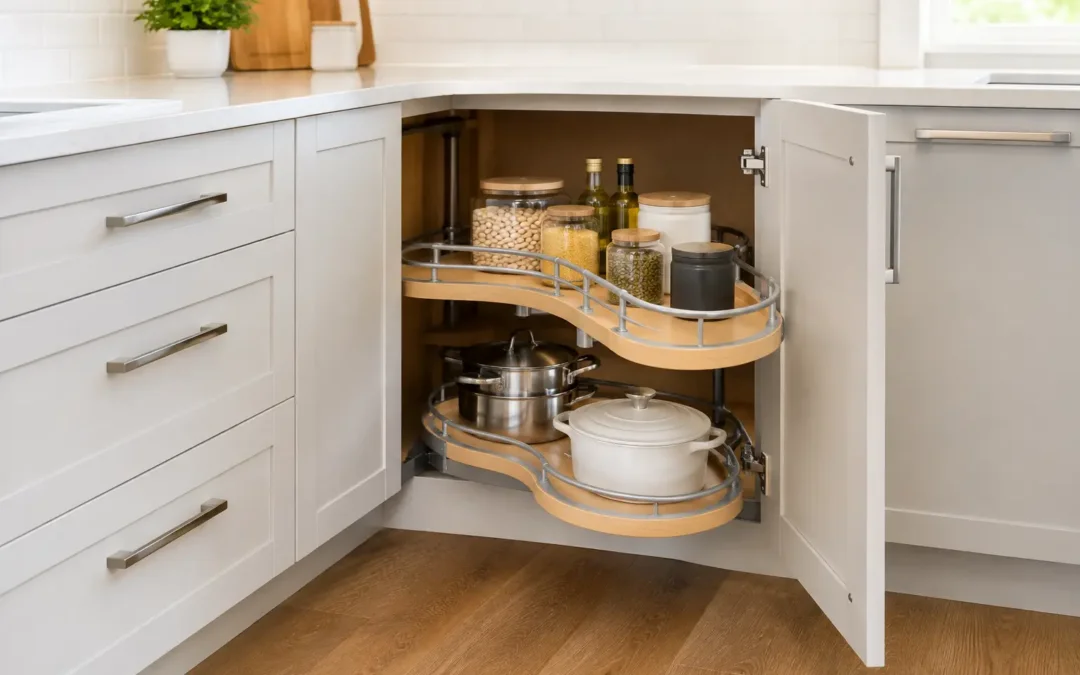
A corner cabinet can look generous on a kitchen plan, then become the place where baking tins, serving bowls and rarely used gadgets disappear. The best kitchen storage for corners does not simply fill that awkward footprint. It makes the full depth of the cabinet easy to reach, suits the way you cook and earns its place in the overall budget.
For a family kitchen, that may mean accessible storage for everyday pans. In a more compact room, it could mean preserving valuable worktop space and creating a clean, uninterrupted run of cabinetry. There is no single answer for every home, but there are clear reasons why some corner solutions work better than others.
Why kitchen corners need careful planning
A standard corner base unit has a surprisingly large internal volume, but its shape is the problem. Reaching into the back usually means kneeling, stretching and moving everything at the front first. That is not a good use of prime kitchen storage, particularly when the cabinet is beside the hob or within a busy preparation area.
The right choice depends on the kitchen layout, cabinet width, door style and what you intend to keep there. It also depends on priorities. A highly engineered pull-out gives excellent access, but costs more than a fixed shelf. A simple cupboard may be perfectly sensible for occasional items, while a keen cook may value the convenience of a mechanism every day.
Corner storage should be decided early, not added at the end. It affects cabinet sizes, adjacent drawers, appliance positions and the worktop layout. A well-designed corner can improve the whole working area; a poorly planned one can leave an expensive kitchen feeling less practical than it should.
The best kitchen storage for corners by use
Pull-out corner systems for everyday access
For many homeowners, a pull-out corner system is the strongest all-round choice. These mechanisms bring shelves forward and out of the cabinet, allowing you to see and reach cookware, mixing bowls or dry goods without searching in the dark.
Two common styles are kidney-shaped pull-outs and systems with linked shelves that swing or slide out in stages. The best option is not automatically the one with the most moving parts. Look at the available shelf area, the stated weight capacity and how naturally the shelves move. Good-quality mechanisms should feel controlled and stable when loaded, rather than needing a firm tug or careful balancing.
Pull-outs are particularly worthwhile beside the hob, where saucepans and heavier cooking equipment need to be close to hand. Their trade-off is cost. They also use some of the cabinet volume for the mechanism itself, so they are about better access rather than maximum raw capacity.
A carousel for simple, familiar storage
A carousel, often called a lazy Susan, uses rotating circular or kidney-shaped trays. It remains a popular solution because it is straightforward, relatively economical and easy to understand. Turn the shelf and the contents come towards you.
It can work well for lighter, bulky items such as serving dishes, cereal containers, small appliances or food-storage boxes. However, it is not always the best home for heavy pans or lots of loose items. The round trays can leave unused space at the corners of the cabinet, and a crowded carousel can become frustrating if items topple or catch as it turns.
Choose a carousel with sturdy central support, raised shelf edges and smooth rotation. It is a practical middle ground where the budget does not extend to a premium pull-out, but access still matters.
Corner drawers for a clean, modern layout
Corner drawers are often overlooked because they appear more complex from the outside. Properly planned, they can be one of the most useful and attractive options. The drawer fronts follow the corner shape, creating wide drawers with easy access from above.
This is particularly effective for utensils, pans, food containers and tableware. You can see the contents at a glance, organise them with internal dividers and avoid the need to bend into a cupboard. In a contemporary kitchen, corner drawers can also maintain the calm horizontal lines of a drawer-led design.
The compromise is that specialist corner drawers are a premium cabinet solution and must be designed precisely around adjoining units. They are best considered when accessibility and visual simplicity are both high priorities, rather than as a late substitution for a standard cupboard.
A straightforward corner cupboard for occasional items
Not every corner needs an elaborate mechanism. A standard corner cupboard with fixed shelving can be an honest, cost-effective answer when it is used for items you do not reach for every day. Think seasonal servingware, large platters, spare vases or party equipment.
The key is to store it deliberately. Keep frequently used items at the front and reserve the farthest area for the genuinely occasional pieces. Pull-out baskets or labelled containers can improve the experience without the cost of a full corner mechanism.
This approach can make sense where the budget is being directed towards other valuable features, such as larger pan drawers, a quality worktop or better internal organisation elsewhere. There is little value in paying for complex corner storage if it will only hold the fondue set and Christmas plates.
Diagonal corner units and larder-style solutions
A diagonal-front corner cabinet creates a single door across the corner rather than two doors meeting at an angle. It can give a more generous opening and can house a carousel or pull-out system neatly. It is often suited to traditional kitchen designs, where the shape feels intentional rather than compromised.
In some layouts, the best answer is to avoid a deep corner base cabinet altogether. A tall larder at the end of a run, a shallow pantry cupboard, or a carefully positioned open shelf may use the space more effectively. This is especially true in smaller kitchens where an awkward corner door could clash with an appliance, doorway or neighbouring drawer.
Choose storage around how you actually cook
Start by thinking about the items that create clutter now. If saucepans are stacked three deep in a cupboard, accessible pull-outs or corner drawers may make a meaningful difference. If food packets spread across several cabinets, a tall pull-out larder may solve more than a corner carousel ever could.
Also consider who uses the kitchen. Deep, low cupboards are difficult for people with reduced mobility, while drawers and pull-outs bring contents within reach. Young families may prefer a solution that keeps heavier items secure and out of easy reach. For households that entertain often, a corner used for platters and glassware might be more valuable than one filled with everyday cookware.
A good kitchen plan does not try to make every cabinet do everything. It places storage where it supports a natural routine: preparation near the worktop, pans near the hob, crockery near the dishwasher and food near the point where it is unpacked or prepared.
Details that make a corner solution last
Whatever mechanism you choose, pay attention to build quality. Soft-close doors and drawers are welcome, but the more meaningful factors are solid cabinet construction, durable runners, dependable hinges and a mechanism rated for realistic loads. A corner pull-out full of cast-iron cookware places very different demands on its hardware than one storing plastic containers.
Internal organisation matters too. Non-slip liners, dividers and shelf rails stop contents shifting and help you use the available space properly. Before committing, it is worth opening and operating the solution in a showroom. Check whether the door needs to be opened fully, whether handles could clash and whether the movement feels comfortable for you.
At MBK Design Studio, kitchen planning begins with listening to how a household wants to live in the space. That is particularly valuable with corners, where the most impressive-looking option is not always the most useful one for the room.
A corner should never be treated as leftover space. With the right cabinet and a clear idea of what belongs inside it, it can become one of the hardest-working parts of your kitchen rather than the cupboard everyone avoids.